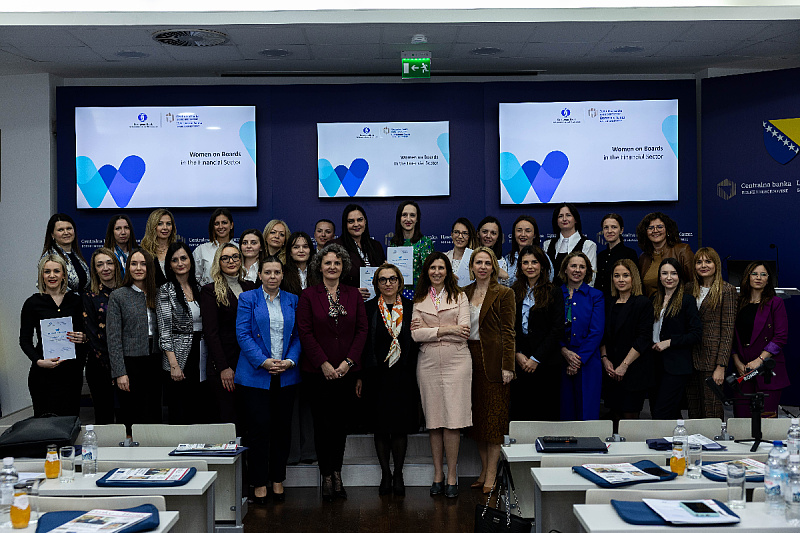
The program was implemented by the European Bank for Reconstruction and Development (EBRD) in collaboration with the Central Bank of Bosnia and Herzegovina (CBBiH), with the aim of strengthening women's capacity to take on roles in management and supervisory boards, and enhancing corporate governance standards in the financial sector.
Through a carefully structured four-month program, participants explored key topics that define effective performance at the board level—including corporate governance, strategic decision-making, financial expertise, risk management, compliance, and board dynamics.
The program was based on a combination of expert lectures, practical examples, and interactive discussions, along with direct exchange of experiences with prominent leaders from the financial and business sectors. This approach enabled participants to view the acquired knowledge through real business situations and further strengthen their readiness to take on responsibilities at the highest decision-making level.
Perspective of Participants: Concrete Experience and Long-Term Value
The value of the program is particularly reflected in how participants connected theoretical knowledge with practical challenges from their daily work. As Nikolina Erak, Secretary of the Bank at Nova Banka AD Banja Luka, points out, participation in the program was of exceptional importance precisely because of the balance between developing professional competencies and strengthening mutual connections: "Participation in this carefully organized program has been of immense value, considering its focus on education and developing the necessary skills for good corporate governance, while never overlooking the need to strengthen community and diversity. The program inspired me with its authenticity and empowered me in my further professional development. The knowledge and experiences shared during the program are invaluable for creating a support network to overcome challenges that arise in our career paths."
A similar perspective is shared by Jasmina Šabanović-Bajrović, Head of the Business Compliance Department at Bosna Bank International d.d., who emphasizes that the program provided a broader view of the role of women in management structures: "Participation in the Women on Boards in the Financial Sector program was a highly valuable professional experience for me. The program allowed me to look beyond the framework of daily responsibilities and see the bigger picture of the role and contribution of women in the management structures of the financial sector, particularly through the lens of responsible leadership and strategic decision-making. The most useful aspects were the exchange of concrete experiences from practice, open discussions about sector challenges, and the mentoring approach that provided additional clarity in leading teams and projects."
Such experiences confirm that the program not only contributes to individual development but also strengthens the professional community, which has the capacity to contribute to improving governance standards in the financial sector.
Strengthening Leadership and Decision-Making Quality in the Financial Sector
The significance of the Women on Boards in the Financial Sector program is further confirmed by institutional perspectives that highlight its long-term impact on the development of a more stable, inclusive, and better-led financial sector in Bosnia and Herzegovina.
From the perspective of the EBRD, a key result is reflected in the concrete contribution to the development of inclusive leadership and the strengthening of governance standards in the sector. As Stela Melnic, EBRD Director for Bosnia and Herzegovina, points out, investing in the development of women leaders has a direct impact on the quality of decision-making and the resilience of the entire financial system: "The successful completion of the Women on Boards in the Financial Sector program demonstrates the real impact of investing in people and inclusive leadership. By providing successful women with practical skills, strategic insights, and peer support, we strengthen corporate governance and enhance the quality of decision-making across the entire financial sector. I would like to sincerely thank the Central Bank of Bosnia and Herzegovina for the strong partnership and shared commitment to these goals. To the women who participated in this program, I say: believe in your expertise, support one another, and do not hesitate to take your seat at the table—your voice and your leadership truly matter."
As emphasized by the Governor of CBBiH, Jasmina Selimović, this program is part of a broader institutional responsibility: "I am extremely pleased that we have successfully completed the Women on Boards program and that the Central Bank of Bosnia and Herzegovina, in partnership with the European Bank for Reconstruction and Development, had the opportunity to contribute to strengthening the knowledge and competencies of women for participation in management and supervisory boards in the financial sector. For the Central Bank of Bosnia and Herzegovina, this is not just support for education but also part of the broader responsibility we have toward the stability of the financial system. I would particularly like to highlight four key values that were the focus of the program: trust, professional integrity, transparency, and diversity. These are precisely the values that the Central Bank of Bosnia and Herzegovina consistently promotes and which we consider the foundation of any quality governance system."
These perspectives further confirm that investing in the development of competencies and empowering women to participate in management structures is not only a matter of equality but also an important factor in improving the quality of decision-making and the long-term resilience of the financial system.
As Sabina Softić, Director of Deloitte Bosnia and Herzegovina, also points out, such initiatives have broader significance for the development of leadership and the business community: "The Women on Boards in the Financial Sector program demonstrates how important it is to systematically invest in leadership development and create opportunities for women to take a more active role in decision-making processes. Through this program, we clearly see that there is strong potential and readiness among participants to contribute to improving governance standards in the financial sector. What makes this program particularly valuable is the combination of knowledge, exchange of experiences, and mutual support, which in the long term contributes to strengthening the professional community and making better decisions at the highest level."
In this way, the program not only addresses current market needs but also lays the foundation for long-term changes in how leadership is developed and applied in the financial sector.