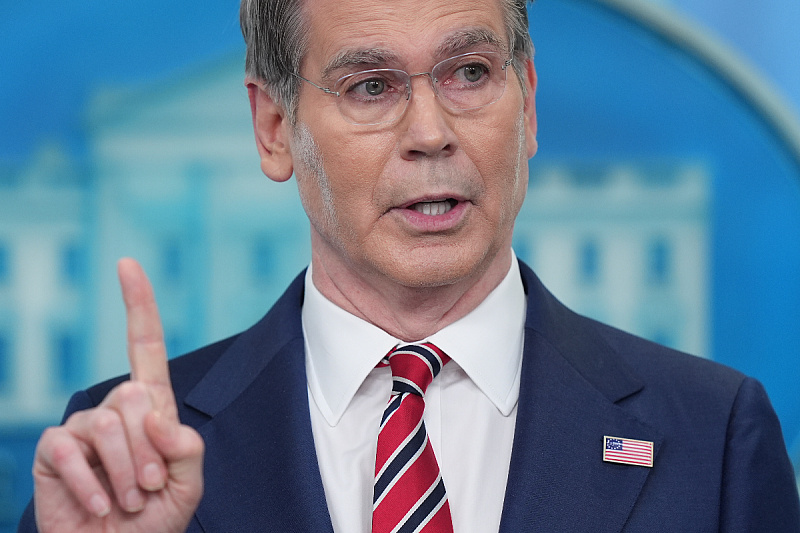
Finance Minister Scott Bessent told reporters at a White House briefing on Wednesday that the U.S. plans to intensify economic pressure on Iran, stating that new measures will be the "financial equivalent" of bombing. Bessent said the administration has warned companies and countries that if they purchase Iranian oil and hold Iranian funds in their banks, they should be prepared to face secondary sanctions. "And the Iranians should know that this will be the financial equivalent of what we have seen in kinetic activities," he said. The warning comes a day after the Treasury Department sent letters to financial institutions in China, Hong Kong, the UAE, and Oman, threatening to impose secondary sanctions for doing business with Iran and accusing those countries of allowing illicit Iranian activities to flow through their financial systems. "This is part of the economic playbook that Donald Trump can still use to pressure Iran into accepting U.S. proposals to curb its nuclear ambitions," a source familiar with the administration's thinking told The Associated Press. The person spoke on condition of anonymity because they were not authorized to discuss internal deliberations publicly. Possible Freezing of Iranian Funds In private discussions, the argument presented to Trump is that Iranians believe they can withstand pressure, but if they cannot pay their loyalists, it could force Tehran to the negotiating table. Some in the administration believe there are still additional economic targets that can be hit to inflict even greater economic damage on Iran, including bonyads, charitable foundations that make up a significant part of the Iranian economy. Bessent told reporters that two Chinese banks have received warnings regarding their handling of Iranian funds. Bessent also said that Iran's neighbors in the Gulf are now prepared to consider freezing Iranian funds in their banks due to Iranian aggression during the war. Sanctions lawyer Daniel Pickard warned that imposing secondary sanctions could trigger a "diplomatic and economic backlash" from allies, which could complicate efforts to build coalitions against Tehran. "Many of our trading partners have been very vocal about their opposition to conflict with Iran. Most economic sanctions experts would agree that when you have more people on the team, the chances of your economic sanctions being effective are greater," Pickard said. On Wednesday, the U.S. imposed sanctions on an oil smuggling network linked to the late senior Iranian security official Ali Shamkhani, who was a close advisor to Iran's former supreme leader. The sanctions target dozens of individuals, companies, and vessels involved in the covert transport and sale of Iranian and Russian oil through front companies, many of which are based in the UAE. "The Treasury Department will continue to cut off Iran's illicit smuggling and terrorist financing networks. Financial institutions should be aware that the Treasury Department will use all tools and authorities, including secondary sanctions, against those who continue to support Tehran's terrorist activities," Bessent said in a statement. Additional Pressure on Tehran Trump administration officials have also signaled growing confidence that the ceasefire and the blockade of shipments from Iranian ports in the Strait of Hormuz have shifted momentum in Trump's favor. Vice President JD Vance said on Tuesday that Trump "does not want to make a small deal but wants to achieve a grand bargain." "That is the offer he is making. If you commit to not having nuclear weapons, we will make Iran flourish," Vance stated. Deputy White House Chief of Staff Stephen Miller offered a much sharper assessment of the current situation, suggesting that Trump has "checkmated" Iran by imposing the blockade in the strait. "If Iran chooses the path of agreement, which is great for the world, that is good for everyone. If Iran chooses the path of economic strangulation through blockade, then the world will leave Iran behind. New energy routes will be established. New supply chains will be set up. Other nations across the region, across the world, and especially America, will power the world with energy, and Iran will become a footnote," Miller said during an appearance on Fox News on Tuesday evening. Some Republicans believe it is worth trying any tactic that can further pressure Tehran. "I would support anything. If the administration is brainstorming ideas, I would support all of them. The more pressure, the better," said Senator Thom Tillis, a Republican from North Carolina. Others are skeptical, noting that Tehran is already facing a series of economic penalties that have had little impact on its behavior. "I'm not sure it will be sanctions. I think we are already imposing pretty severe sanctions. Personally, I am not optimistic that we can truly resolve this without a change in regime," said Senator Mike Rounds, a Republican from South Dakota and a member of the Banking and Armed Services committees. Trita Parsi, executive vice president of the Quincy Institute, a think tank critical of Trump's decision to launch the war, says that before the ceasefire announcement, Trump was "politically cornered and strategically constrained." But now, Parsi argues, Trump may have managed to shift the unfavorable dynamics and create a situation where "it seems Iran now needs a deal more than the U.S. does." "The now-open window offers Tehran a chance to translate battlefield advantage into lasting strategic gain," Parsi wrote in a new analysis.
Society
SAD is preparing a new terrain for Iran: Moves will be the "financial equivalent" of bombing.
If the United States and Iran do not soon reach an agreement to end the war or extend the ceasefire that expires next week, the Donald Trump administration is preparing to shift the war campaign to an economic one, aiming to force Tehran to concede by strangling its economy.
ingestion