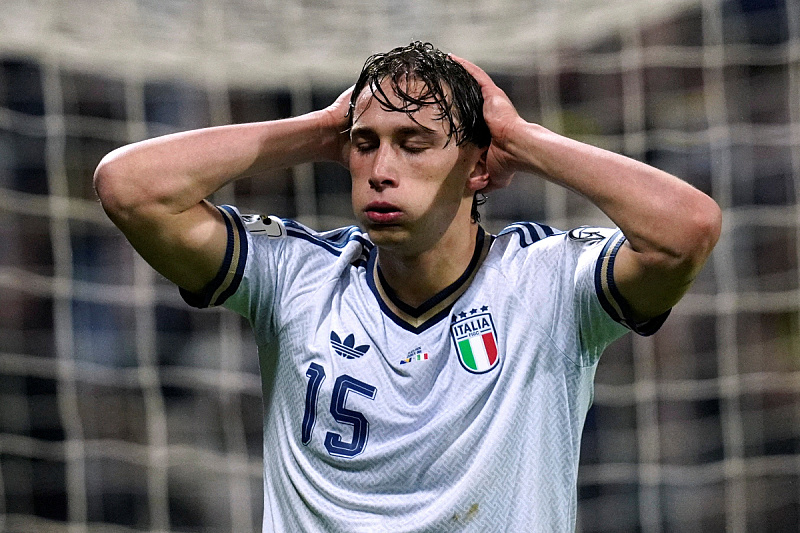
The debacle in Zenica has triggered a true football earthquake that has now spilled over onto the political stage, bringing the debate about the "collapse of Italian football" to the country's parliament.
The consequences of missing another World Cup are catastrophic. After the head of the Italian Football Federation (FIGC), Gabriele Gravina, resigned, taking responsibility for the debacle against the Dragons, Italian politicians are now demanding direct answers from the state's top officials.
"They stole the dreams of our youth" Salvatore Caiata, a deputy from the "Brothers of Italy" (FdI) party led by Prime Minister Giorgia Meloni, requested that Sports Minister Andrea Abodi submit an official report to parliament on the national team's failure. Caiata sharply criticized the now-former Federation President Gravina.
"He stole the dreams of our young people. The younger generations have never witnessed a World Cup match and those magical nights of 1990," Caiata stated.
His request was also supported by Mauro Berruto from the opposition Democratic Party (PD), emphasizing that he wants to hear explanations from Minister Abodi, as well as concrete measures to correct this disastrous trend.
"Gravina's resignation should not have been forced; it should have been an act of basic institutional dignity," Berruto added.
The problem is much deeper than Gravina Members of the opposition Five Star Movement (M5S) on the Culture Committee of the Lower House of Parliament warned that the problem is not just about one man.
"Let's remember that Gravina was elected with almost 100 percent of the votes in February last year. A complete cleanup is needed because the problem is structural. We have a system subordinated to the interests of clubs, focused on paying record commissions to managers (the highest in Europe!), and completely neglecting talent development," the party stated.
They also raised direct questions about the clubs' responsibilities:
When will clubs be required to invest in young players? Why are they allowed to obstruct national team gatherings to play the Super Cup in Saudi Arabia or meaningless tours in Australia?
"We are constantly chasing emergencies without ever addressing the foundations. Meanwhile, an entire generation is growing up that has never experienced the national team playing in a World Cup. Continuing like this is no longer acceptable," Italian parliamentarians made clear.
Zenica as a trigger for change Recall that the trigger for this unprecedented crisis in Italy was precisely the defeat in Zenica. Gabriele Gravina was in Bosnia and Herzegovina before the match, where he met with the President of the Football Association of Bosnia and Herzegovina, Vico Zeljković, and then watched the game at Bilino Polje. Shortly after the final whistle, he signed the surrender and submitted his resignation.
Italy will elect a new Federation President on June 22, which should mark the beginning of a new era in Italian football. National team coach Gennaro Gattuso is expected to follow the same path as Gravina. Although there is no official confirmation yet, Italians are already eagerly anticipating the return of the legendary Roberto Mancini to the Azzurri bench, as the nation continues to recover from the slap received in Bosnia and Herzegovina.