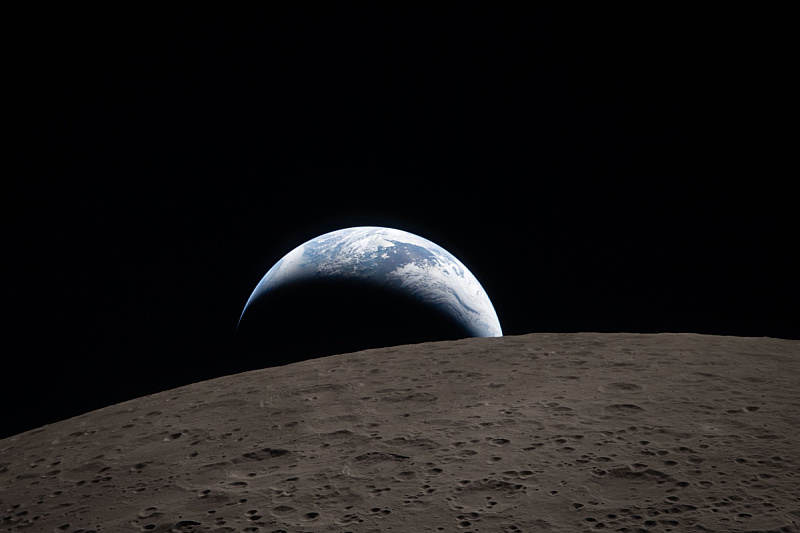
This photograph holds special symbolic significance, as it evokes the famous "Earthrise" image first captured by astronaut William Anders during the Apollo 8 mission. At that time, an analog camera with a telephoto lens of approximately 250 mm was used, and the photo was taken through the command module window at the moment Earth "rose" above the gray lunar landscape. More than half a century later, the Artemis II crew recreated that scene, but with the aid of modern technology. The astronauts used professional Nikon Z9 and Nikon D5 cameras, adapted for space conditions, and lenses ranging from 85 to 400 millimeters in diameter to capture high-resolution photos and videos through the Orion capsule windows. The photography was executed precisely when the Orion capsule emerged from the zone where the Moon blocked the view of Earth, enabling a unique shot of our planet "rising" above the cratered surface of the far side of the Moon. This footage represents not only a visual spectacle but also a significant technological and scientific leap. The Artemis II mission aims to explore lunar orbit in greater detail and prepare for future landings, while also gathering visual data on the part of the Moon that has been out of direct view from Earth for decades. The "Earthrise" photograph from this mission is already considered one of the key moments in modern space exploration, symbolizing humanity's return to deep space.
Society
The Earth has emerged from behind the Moon once again: See the spectacular photo from the Orion capsule
The Artemis II mission crew captured a historic moment during their lunar flyby, taking a spectacular "Earthrise" photograph of Earth rising above the Moon's horizon while on its far side, a part never visible from our planet. The first such photograph was taken in 1968.
ingestion