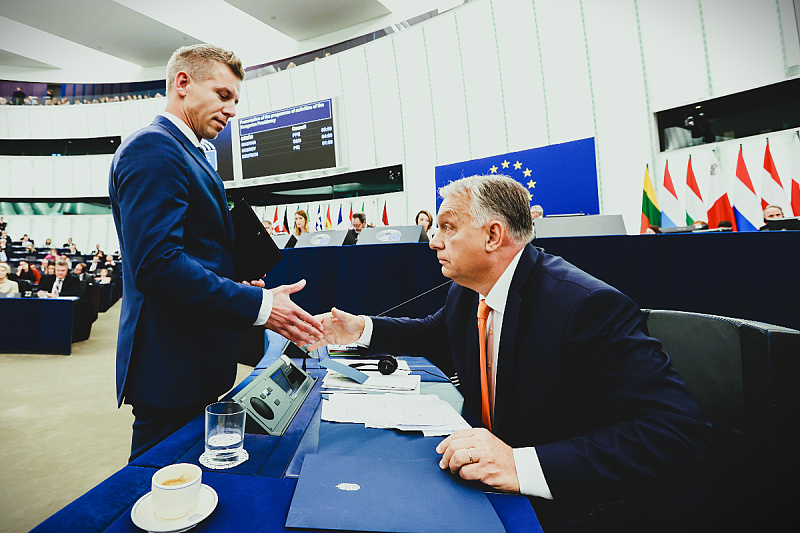
His victory is not merely an internal political matter for Hungary; it is a political earthquake whose epicenter lies in Budapest, yet whose waves of hope and change are felt across the entire continent.
Why is Europe so elated by the fall of the long-serving Hungarian Prime Minister? The reasons are profound, strategic, and, above all, existential for the European Union itself.
A desperately needed victory for the "European idea"
This victory was like water to a parched Brussels. After a series of political "defeats," the rise of Euroscepticism, the strengthening of the radical right in several key member states, and constant internal squabbles, the European idea of community and the rule of law had appeared dangerously vulnerable.
Magyar's victory is the first major, concrete proof in recent times that a pro-European course and the desire for genuine democracy still have the power to mobilize the masses and topple autocratic systems.
This is a clear signal that citizens, when faced with corruption and isolation, still choose the European path. Brussels now has the opportunity to consolidate its ranks and show that the "European family" is not just an empty phrase, but a system of values worth defending.
Direct support from the USA didn't help either
The weight of Magyar's victory and Orbán's defeat becomes even clearer when viewed within the broader international context of the campaign. For months, Orbán had built an image as a global leader of the conservative right, and in the campaign's final stretch, he attempted to leverage his greatest international capital: his connections with the United States and the new American administration.
The direct and unabashed support from American conservatives culminated with the arrival of prominent figures, even including U.S. Vice President J.D. Vance, to Fidesz's pre-election rallies. This show of force was meant to convince Hungarians that Orbán was a world-caliber player protected by a powerful America.
Yet, Hungarian voters showed that their domestic reality—economic stagnation, a collapsed healthcare system, and a lack of freedoms—was far more important to them than foreign applause and ideological performances. Orbán's fall despite such support is a clear indicator that the democratic will of citizens cannot be bought with international sponsorship.
The end of Moscow's "Trojan Horse"
Looking at the geopolitical picture, Viktor Orbán's defeat is simultaneously one of the heaviest political blows to Vladimir Putin on European soil in recent years. Russia had for years found in Budapest its most reliable, and often only, ally within the EU and NATO.
Orbán regularly blocked, delayed, or watered down European sanctions against Moscow and packages of financial and military aid to Ukraine. With his departure from power, Putin loses a key lever for obstruction within European institutions. Europe is celebrating because it can now expect a significantly more coherent, faster, and decisive foreign policy towards the East, without the constant threat of a Hungarian veto.
Finally, Europe rejoices because it has been freed from its greatest internal critic and saboteur. Of all the Eurosceptics and populists, no European leader had managed to shake the very foundations and unity of the European Union as deeply and systematically as Viktor Orbán. His concept of "illiberal democracy" was a direct challenge to the core values upon which the EU is built.
For years, he used the veto right not as an instrument to protect national interests, but as a means of blackmail to extract European funds. The systematic dismantling of the independence of the judiciary, media, and academic community in Hungary set a dangerous precedent that threatened to spill over to other member states.
With the defeat of Viktor Orbán, not only is a new page written in Hungarian history. A dark and exhausting chapter for all of Europe has been closed, making room for the much-desired European reset.