This discovery is not only an archaeological feat but also a dramatic race against time. The site where the ship lies, at a depth of about 15 meters, will soon become a major construction zone for a new residential quarter. Archaeologists are battling near-zero visibility and mud to extract as many artifacts as possible before modern building permanently seals access to history.
"This is a significant part of Danish national identity. Although enthusiasts have written extensively about this battle, we actually don't know what life (and death) on the deck of a ship blown apart by English cannons was really like," stated Morten Johansen, head of the maritime archaeology department.
What have divers found? Although the ship has been underwater for over 200 years, the mud has preserved incredible details that tell the story of the crew's final moments: Human remains: Part of the lower jaw of one of the sailors was found. Weaponry: Two large cannons and numerous cannonballs. Personal items: Uniforms, insignia, shoes, and even glass bottles. Ship structure: Wooden parts whose dimensions perfectly match old drawings of the 48-meter-long ship. Scientific methods and wood analysis have confirmed that the material dates precisely from the period when the Dannebroge was built.
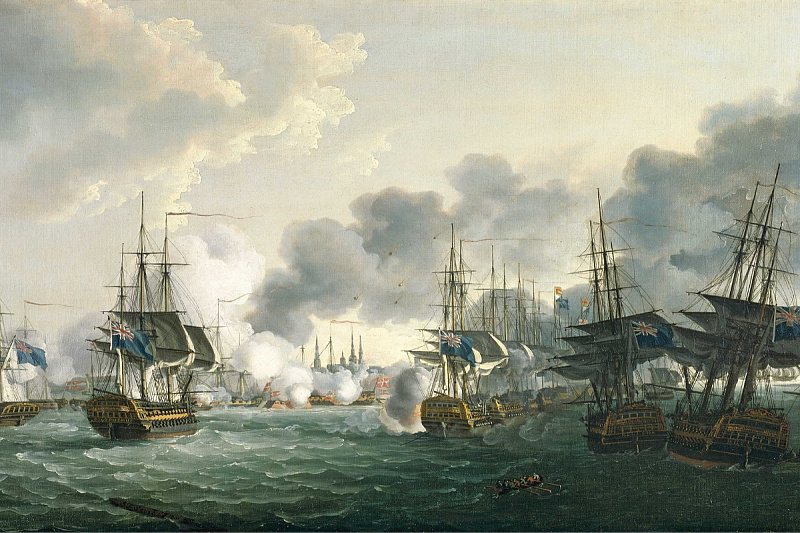
To recall, on April 2, 1801, the British fleet attacked the Danish navy, which had formed a blockade outside the harbor. The aim of the attack was to force Denmark to withdraw from its alliance with Russia, Prussia, and Sweden.
Admiral Nelson directed fire directly at the Dannebroge, commanded by Commodore Olfert Fischer. The ship's upper deck was completely destroyed, and incendiary shells caused a fire that could not be extinguished. As the ship drifted uncontrollably northward, the fire reached the gunpowder storage, leading to a catastrophic explosion that claimed hundreds of lives.
This discovery now provides an opportunity, after more than two centuries, to finally piece together all parts of the puzzle about one of the most severe naval battles in Denmark's history.