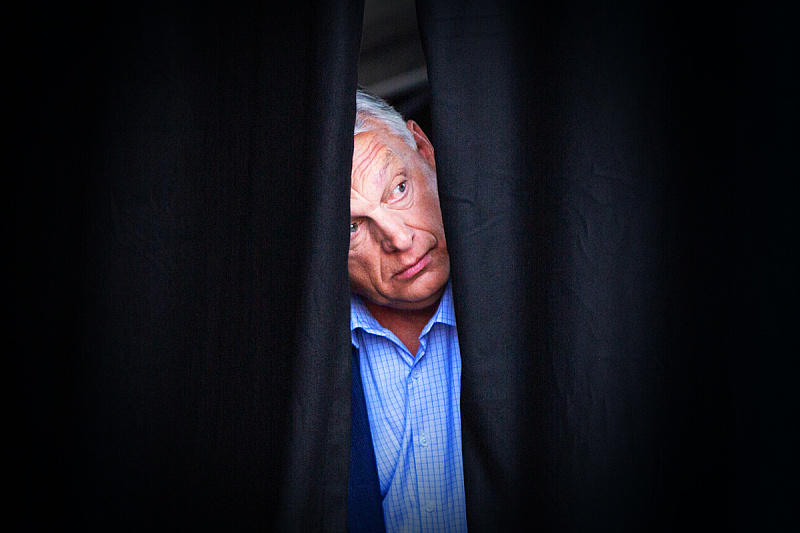
The Tisza Party, led by Péter Magyar, is far ahead of Fidesz in all polls, with some public opinion surveys giving it a lead of more than 10 percentage points. Part of the reason Fidesz is facing defeat is that all attempts by Orbán and his associates to reverse course have ended up losing support and boosting Tisza. To make matters worse for the Hungarian prime minister, at the same time his tactics are failing publicly, there are almost daily information leaks that, based on their content, most likely come from his innermost circle.
All of Orbán’s failures: From sex scandals to "false flags" Fidesz already ceded its position as Hungary’s most popular party to Tisza in December 2024, and since then, it has tried hard to change the situation. The only tactic that succeeded in halting the loss of support, at least briefly, was a one-time aid package for pensioners and socially vulnerable Hungarians, launched by the Fidesz government at the end of last year. After that, whatever Orbán and his associates tried was either thwarted by the opposition or had no effect.
Orbán’s first attempt to bring down Magyar, his former close associate, was a secret recording of the opposition leader with an ex-girlfriend. The sex scandal was meant to tarnish Magyar’s image in traditionally conservative Hungarian society, but this attempt failed spectacularly. The day after a website appeared where Magyar’s recording was supposed to be released, the Tisza Party leader went public and literally preempted Orbán and Fidesz. He said he had consensual sexual relations and there was nothing controversial about it, even adding that this case proves Orbán closely collaborates with Russian intelligence services interfering in Hungary’s electoral process. This attempt failed so badly that the recording was never even released, as the public largely sided with Magyar.
After that, Orbán launched a massive campaign trying to link Magyar with Ukrainian President Volodymyr Zelenskyy. The goal was to convince Hungarian citizens that Magyar would drag Hungary into war and that only Orbán, or Fidesz, could guarantee Hungary’s safety. However, this also failed. Hungarian citizens did not overreact to this, and Magyar again made a politically smart move by completely ignoring the campaign, focusing instead on the messages that had brought his party into an excellent position ahead of the elections.
Orbán’s last attempt may have been his biggest defeat—a "false flag" operation on the border with Serbia. This case showed that failed tactics are not Orbán’s only problem.
The innermost circles have secretly begun to betray Orbán When explosives were found on a section of the TurkStream gas pipeline in Serbia, which supplies Russian gas to Hungary, Orbán and Serbian President Aleksandar Vučić immediately launched campaigns, each for their own reasons. However, that campaign was quickly halted. Just a few hours after the explosives were found, Hungarian journalists published messages from several weeks earlier, in which, they claimed, individuals from Orbán’s closest circle warned them about a "false flag" operation on the border with Serbia. As a result, shortly after the explosives were found—similar to the sex scandal at the start of the campaign—Orbán and his associates abruptly stopped talking about the topic, despite earlier announcements of a state of emergency and even potential election cancellation.
However, this is not the only example of a "stab in the back" Orbán has received from his closest circle. In fact, for several weeks now, every few days, new information has appeared in Hungarian media that could only have been known by someone close to the prime minister. In just a few weeks, conversations between Orbán and his closest associate, Foreign Minister Péter Szijjártó, and Russian officials were made public, revealing many controversial statements. Szijjártó tried to justify himself through social media posts, but reactions to these conversations and the scandal in general clearly show that these justifications cannot help Fidesz.
The timing of the last major revelation was particularly interesting, as it was revealed that Szijjártó called Iranian Foreign Minister Abbas Araghchi after Israel’s pager attack on Hezbollah members. Since a Hungarian company was linked to the pagers, Szijjártó apologized to Araghchi and even offered intelligence assistance to Iran. This conversation was published just as U.S. Vice President JD Vance’s visit to Budapest was ending, where he conveyed the words of his boss and U.S. leader Donald Trump, who supports Orbán. However, it is not entirely clear, nor has it been disclosed so far, how Washington reacted to the fact that its ally offered assistance to a country it is at war with.
Magyar ran an excellent campaign, but Orbán still has a chance When summing up the campaign, it is clear that Orbán simply misread the public mood and underestimated Magyar. Several tactics Orbán tried were thwarted by Magyar, who responded in a timely manner, while others were simply poorly prepared. However, these elections, no matter what the polls suggest, are still not decided. Orbán is counting on diaspora support and the resilience of an electoral system that has given him a two-thirds majority in parliament for 12 years, even though Fidesz has won just over 50% of the vote. If Orbán is ultimately defeated, many factors will be behind it, and among the most important will certainly be that Fidesz’s campaign was a complete failure.