According to pre-election polls, the opposition party Tisza, led by former Fidesz operative Péter Magyar, holds a lead of seven to ten percent, which under normal conditions would be the closest guarantee of success. However, after 16 years of rule by one man, particularly one with serious authoritarian tendencies, it is difficult to speak of normal conditions in Hungary.
Orban has played it smart, using power to build an "electoral wall." Since its election victory in 2010, Fidesz has sovereignly governed every part of Hungarian society, with a particular focus on the electoral system. This was aided by the fact that in every election since 2010, they have held an absolute, or two-thirds, majority.
Above all, upon coming to power, Orban embarked on a kind of "dismantling" of the system he inherited. The result is that in the subsequent electoral processes, with just over 50 percent of the national vote, Fidesz secured two-thirds majorities in parliament. The main reason for this is the redrawing of electoral maps, a tactic often used in the U.S.
The principle Orban followed is very simple: electoral maps are drawn to reduce the number of districts where the opposition holds a majority, while areas where Fidesz has more support are split into as many districts as possible. In practice, this often looks awkward, with situations where one half of a street votes in one district and the other half in another, but for Orban, it has proven an excellent way to maintain full control over political processes in Hungary.
However, Orban's main weapon is not electoral engineering, but the diaspora.
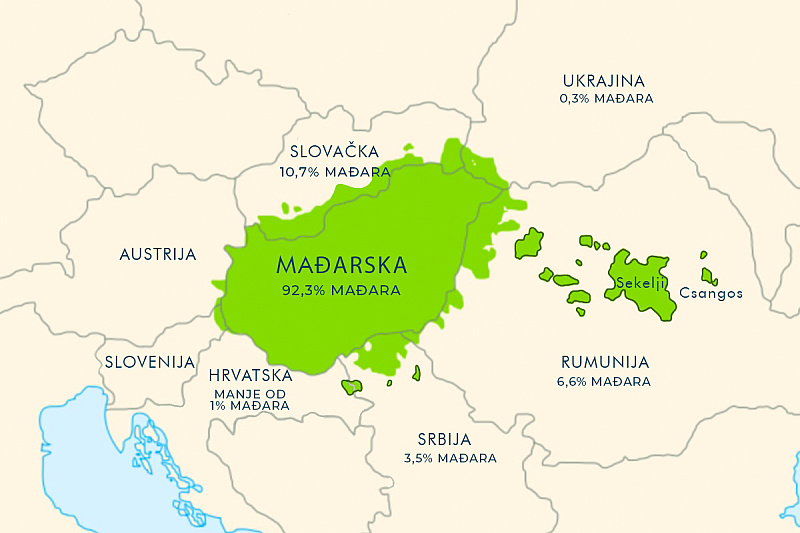
The numerous diaspora as Orban's ace up the sleeve. Over the 16 years that Orban has sovereignly ruled Hungary, one of the key changes has been providing ethnic Hungarians in neighboring countries the opportunity to obtain a Hungarian passport with relative ease and then granting them voting rights essentially identical to those of citizens living in Hungary. Essentially, this added over 1.5 million voters to the electoral rolls in a country where, in the previous 2022 elections, 7.7 million people living in Hungary had the right to vote.
To put this in context, four years ago, just over three million people voted for Fidesz, while the largest opposition party received 1.9 million votes. Considering all this, the diaspora emerges as a serious voting bloc that, if secured by one party or bloc, can cushion a weaker result within Hungary itself. This is particularly important to emphasize because poll results are based solely on people living in Hungary, and the diaspora is not included in pre-election public opinion surveys.
Thus, Tisza clearly has an advantage in Hungary, but diaspora votes could be crucial for Fidesz to at least cushion their popularity, potentially even securing a majority.
We may have to wait several days for full results. Although Magyar, and likely Orban, will react to the results immediately on Sunday evening, potentially even declaring victory, the reality is that the complete picture will only be known several days after the election. This is especially true for this electoral process, where diaspora votes could tip the balance and will certainly take longer to count than domestic votes.
In any case, Orban has done everything in his power to orchestrate the electoral process and protect Fidesz from defeat, and the resilience of the system he built will be tested on April 12.