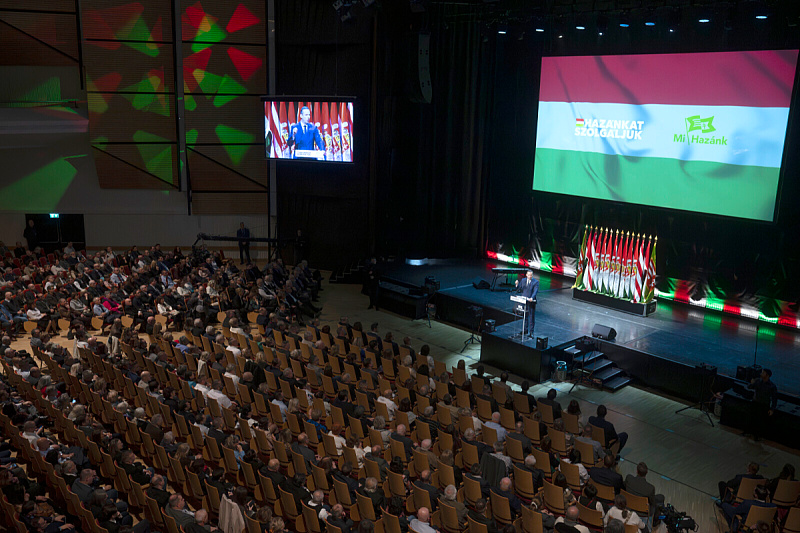
This is about the party Mi Hazánk Mozgalom, or "Our Homeland Movement," which already holds six seats in the Hungarian parliament since the 2022 elections. MHM was founded in 2018 when László Toroczkai was expelled from the conservative Jobbik party for attempting to create a radical faction within it after gaining significant support to become party president. Toroczkai was joined by his closest associate, Dóra Dúró, and MHM officially became a party on June 23, 2018. Unlike the "illiberal" Fidesz, the conservative Jobbik, and the centrist Tisza, MHM is openly radical and does not hide its positions. This party gathers open opponents of the European Union and NATO, as well as those who describe themselves as "Hungarian nationalists." Their views can be described as anti-European, anti-vaccine, anti-communist, and radically nationalist, while certain members also express Islamophobic and anti-Semitic sentiments, though this is difficult to attribute to the party as a whole. In terms of foreign policy, MHM seeks cooperation with BRICS countries, Turkey, and Arab Gulf states. What is particularly interesting is that this party holds an extremely critical stance toward Israel and supports Palestine’s right to independence, setting it apart from other radical parties in Europe. According to pre-election polls, MHM will be the only party besides Fidesz and Tisza to enter the Hungarian parliament, given the five percent threshold that only they surpass. If numerous pre-election polls prove accurate, indicating that Fidesz and Tisza will have roughly the same number of representatives after the elections, MHM could become a key factor in forming a government. Although this party has been part of the opposition for the past four years, arguing that Viktor Orbán and Fidesz are not radical enough, the question remains how they will position themselves if they receive a significant offer to keep the Hungarian prime minister in power for another four years. In any case, the radical right could become a key factor in forming a government and, for the first time in their relatively short history, become part of the ruling majority—a position they could leverage well, even if they likely only secure a few percentage points above the threshold.
Society
Bigger radicals than Orban: Right-wingers who barely enter parliament could be the key to power in Hungary.
Parliamentary elections in Hungary will be held on April 12, and while all analysts and commentators are talking about the battle between the ruling Fidesz and the opposition Tisza, another party is likely to enter parliament and could even be key.
ingestion