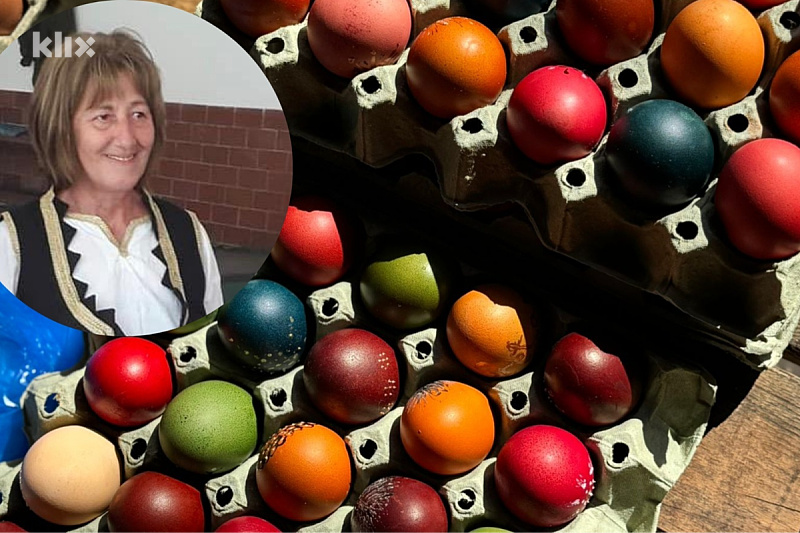
Although snow still lingers at every step, it hasn't stopped the residents of this mining town from filling café gardens and enjoying the warmth that heralds the arrival of Easter. Saturday in Vareš, as always, also means market day—a place for meeting, conversation, and daily life that has a special rhythm here.
At the Vareš market, we spoke with Ljerka Franjić, owner of her own business from the village of Zarudje, where she keeps laying hens. Every Saturday, she is at the Vareš market with her eggs, as well as homemade pasta she produces. However, on the day before Easter, her eggs are colored, and that means only one thing—Easter is here.
Ljerka is also an active member of the "Zvijezda Vareš" Association, as well as the Strica-Zarudje Women's Association, through which she further contributes to preserving tradition and community in this region.
Speaking about Easter then and now, she says the essence of the holiday hasn't changed.
"There isn't much of a big difference. The tradition has been maintained and is passed down from generation to generation."
Preparations for Easter, as she explains, begin much earlier.
"It's hard to say where to start, because everything actually begins forty days earlier through Lent and fasting. The fast is broken on Maundy Thursday, which symbolizes the Last Supper. Good Friday is a day of fasting and great silence, and on Holy Saturday, people go for the blessing of food," Franjić tells us.
For the blessing, she says, people bring what they wish, but cheese and boiled eggs are mandatory, along with bread, ham, and other things.
"In the past, it was more modest—they would bring salt, cheese, and eggs, but today it's a bit richer," she clarifies.
Easter in Vareš is also special because of the guardians of Christ's tomb—the "žudije," a custom that today is celebrated only in Vareš.
"It's special. We have guardians of Christ's tomb, the žudije. It's a custom that today is celebrated only in Vareš, and that is precisely one of the special features of our Easter. At midnight, when the tomb is opened and the resurrection is announced, they fall before the tomb because Christ is no longer there—he has risen," our interviewee tells us.
Children also hold a special place in this holiday, as they still love Easter eggs.
"Even today, children are more drawn to eggs than money. You can have whatever you want, but if you haven't prepared an egg for a child, it's as if you've given them nothing. And today, on Easter, children go from house to house with baskets, give greetings, and receive eggs—a custom that is still joyfully nurtured," Franjić tells us, visibly cheerful and happy about this fact.
What makes Easter in Vareš perhaps most special is the togetherness of people.
"Here, all holidays are celebrated together—Easter, Eid, and Easter again. We visit each other, go to each other's lunches, regardless of faith."
Easter, she says, is celebrated within the family circle, but also the wider community, and she is happy that the village isn't empty and that everyone shares together.
Easter Day itself passes with socializing and the traditional egg cracking.
"After breakfast, the young people with their children organize lunch, and then follows the egg cracking, which lasts all afternoon. Friends, relatives, and even people of other faiths are there—everyone is welcome," Franjić tells us, adding:
"There is a traditional dance at the community center. The doors are open to all."
One of the special traditions still preserved today is decorating eggs with wax, an old method of decoration passed down to younger generations through workshops and the work of associations.
In Vareš, Easter is thus not just a religious holiday, but also a celebration of tradition, family, and community—a reminder that the most important values are precisely those shared with others.