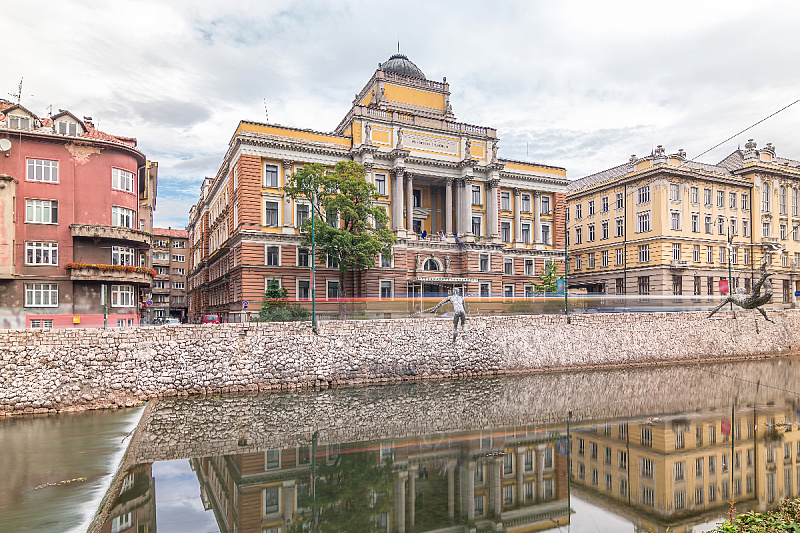
An open letter has been addressed to the councilors of the Sarajevo City Council regarding the proposed Regulatory Plan for Quadrant C – Marijin Dvor, which is on the agenda of the upcoming City Council session. The Senate of the University of Sarajevo reminds that at an extraordinary session held on April 15, 2026, it adopted a Conclusion addressing the City Council and explaining its opposition to the proposed solution.
It is stated that, despite detailed objections raised during the public debate, the plan still envisions the construction of roadways and parking spaces on the land legally owned by the University of Sarajevo, where the buildings of the Faculty of Natural Sciences and Mathematics and the Faculty of Mechanical Engineering are located. It is emphasized that the solution is not merely a matter of property-legal relations but goes a step further, as it plans to convert all green areas around these buildings into parking spaces for the needs of the existing facilities, whose number of floors and construction volume have been significantly increased compared to the current state.
The Senate stresses that any planning solution that encroaches on the property and functional integrity of the University must be based on the principle of proportionality and clear proof of public interest, which has not been done in this specific proposal, especially considering the existence of an alternative solution that does not produce harmful consequences. According to the letter, the most significant investors of the facilities planned within Quadrant C have expressed agreement to relocate the roadway in accordance with the University’s proposal, which the Senate cites as confirmation that the University’s proposal does not represent an obstacle to investment development but rather a sustainable solution acceptable to key stakeholders.
The document states that the proposed Regulatory Plan directly and seriously threatens the safety of students and employees, disrupts the unified functional and research integrity of the University, compromises the vision of a green and open Campus, and places individual interests above the public good. Due to the intensity of daily movement of students and employees between university buildings, the proposed traffic solution, as the Senate points out, represents an unacceptable risk of traffic incidents and undermines the basic conditions of a safe academic environment.
The Senate reminds that the Government of the Sarajevo Canton has given full support to the project of the University of Sarajevo Campus as a pedestrian zone and a center of knowledge, innovation, and research. Adopting the plan in its current form is assessed as a serious deviation from these strategic commitments and a direct threat to the long-term vision of the University’s development and this part of the city.
Therefore, the University of Sarajevo clearly proposes to the councilors of the City Council not to consider or adopt the proposed Regulatory Plan for Quadrant C – Marijin Dvor, submitted by the mayor as the proposer and preparer, in its proposed form, but to return it to the drafting authority, the Sarajevo Canton Development Planning Institute. The reason cited is that the planning solutions concerning the land owned by the University are not aligned with the interests and developmental needs of this institution.
The letter emphasizes that this proposal does not question the Regulatory Plan itself or the development of this part of the city, but rather that the University offers a reasonable, expert, and responsible solution that simultaneously enables urban development and protects university property and academic space as a public good, without jeopardizing the safety and lives of students.
The Senate stresses that the University remains committed to the city’s development and the construction of facilities that bring new value to Sarajevo and should represent a distinctive feature of the city in the future. At the same time, it is emphasized that the Senate cannot support the Regulatory Plan in its proposed form, as it believes the proposed solution encroaches on the University’s property without its consent.
It is announced that, in case the University’s request is not accepted, this institution will take all available measures to protect its rights and interests, and that all objections, analyses, and evidence collected during the process will be made available to the public. The University considers it absurd that an institution of the highest public significance must, as a last resort, defend the public interest through an open letter to the City Council members, given that earlier proposals submitted through the public debate were, as stated, ignored.
The Senate reminds that the substantive basis of democratic decision-making requires that the City Council itself be the guardian of the public interest and ensure that the spatial development of Sarajevo aligns with the needs of citizens, especially institutions of special social significance such as the University of Sarajevo. Councilors are called upon not to allow the jeopardizing of the public interest of the oldest and largest higher education institution in Bosnia and Herzegovina, its students, and employees.
It is further emphasized that in such a situation is an institution that possesses expertise in all segments necessary for the preparation and evaluation of a regulatory plan—from legal aspects of property relations, through traffic and urban planning, to environmental protection and sustainable development. Instead of being a natural partner and scientific support for planning decisions, the University has, according to the letter, been placed in a position to defend itself from the consequences of unilateral preparation and adoption of the plan proposal without prior consultations and despite the University’s clear opposition.
In the final part of the letter, it is emphasized that councilors, when deciding on this Regulatory Plan, are not only deciding on technical solutions but also on the daily safety of students and employees, on the university space, and on the direction of Sarajevo’s future development. It is pointed out that there is no abstract or collective responsibility, but that each councilor individually bears full responsibility for their vote.
It is stated that any vote for the adoption of the Regulatory Plan in its existing form would mean a conscious decision to forcibly seize the University’s property and directly endanger the safety of students and the entire academic community of the University of Sarajevo. Councilors are called upon to stand in defense of the University and its property, as well as the uninterrupted conduct of classes in the halls and laboratories built by previous generations, and to make a decision in the interest of current and future generations of the University of Sarajevo.
The Senate calls on them to base their decision on expertise, legality, and the public interest, while considering the University’s objections and proposals on the Draft Regulatory Plan for Quadrant C – Marijin Dvor. In conclusion, it is emphasized that protecting academic space, student and employee safety means protecting the future of the city and the state, and that the Sarajevo City Council is the last place where this idea should be questioned.