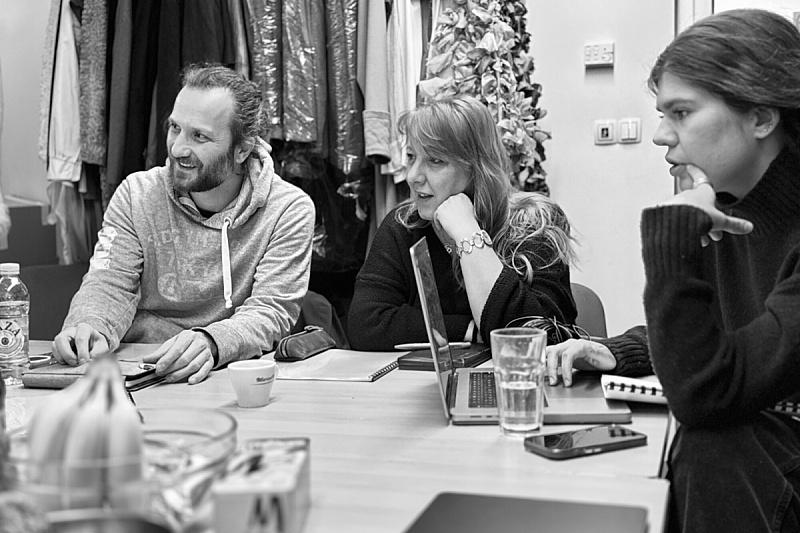
Alongside director Isidora Ratković, the creative team includes dramaturge Vedrana Božinović, costume and set designer Adisa Vatreš Selimović, choreographer Thomas Steyaert, and composer Nedim Zlatar. The acting ensemble consists of Jasenko Pašić, Ana Mia Karić, Adnan Kreso, Mirela Lambić, Enes Kozličić, and Amar Selimović.
Director Isidora Ratković expressed great joy and gratitude that her first professional theater process after graduating from the Academy is taking place at SARTR, emphasizing her particular appreciation for this ensemble as well as the theater's repertoire openness.
"Already at the first reading of Ödön von Horváth's 'Kazimir and Karolina,' I was struck by how powerfully it resonates with our current social moment—certain sentences seem to echo what I read daily in the news and sense as a possible future. Together with dramaturge Vedrana Božinović, through adaptation, we aimed to establish a dialogue with the text, starting from themes that most interested me as an author: Does a person—especially a man—have social value if they lack a job or money? The play's anti-dramatic quality emphasizes the impossibility of truly ascending the social hierarchy, while the Oktoberfest in the background uneasily hints at the rise of fascism. Simultaneously, themes of violence against women and ageism, particularly in the context of the female body, are opened. We strive to keep the process open to improvisation and collective discovery, hoping that the final production will be lively in relation to the audience—establishing a dialogue, offering recognition of contemporary references, and space for intellectual and emotional engagement," she stated.
According to dramaturge Vedrana Božinović, "Kazimir and Karolina," a play by Ödön von Horváth, was written in 1932, which is not just a historical fact but also a dramaturgical key. Horváth wrote this piece at a time when Europe was sliding toward catastrophe. Europe and the world were in the midst of the Great Economic Depression (1929–1933). The consequences in Germany and Austria were mass unemployment, poverty of the middle class, and a sense of hopelessness. Thousands of laid-off workers became typical products of the crisis. An unemployed person loses income, identity, and dignity. The Weimar Republic is nearing its end—democracy is weakening, society is disoriented, distrust and frustration are growing. People seek security, simple solutions, and someone to blame. Horváth sees what is coming: a mass that will accept authority.
Horváth sets the plot at the famous Oktoberfest in Munich: "Celebration, alcohol, crowds, noise, oblivion. And beneath it all lies collective anxiety. People are having fun while their world is falling apart. That is the image of Europe before the catastrophe. And where is love in all of this? In a world slowly rotting, are marriage and love merely economic categories? Is security more important than emotion? We are staging 'Kazimir and Karolina' at SARTR today as a contemporary play because that is what it is. Characters appear on stage who are simultaneously inhabitants of our world and the one that sank into the darkness of World War II. We tell a story about love—and whether it can exist. About a society where it is easier to fall than to rise. About the monsters from the freak show that we watch, not forgetting that some watch us in our own circuses. We talk about the world of the petty bourgeoisie—the illusion of morality, obsession with status, and fear of poverty. About a world that pretends stability but rots from within. About a world where emotion has no value, morality is flexible, and survival is the only law. About our world. And in all of this, we are having a great time. It's Oktoberfest. The music is loud. The lights are flashing. Is love worth anything if you have no money?"
The Sarajevo War Theater SARTR continues its commitment to collaborating with young directors. This theater season, as well as 2026, is largely dedicated to debutants and young authors.
"It is a particular pleasure for us that young Bosnian-Herzegovinian director Isidora Ratković is with us in the process of working on the play 'Kazimir and Karolina.' This collaboration represents great joy for SARTR, but also an important step in continuously opening space for new artistic voices. We believe that, in addition to production and staging new plays, it is extremely important to empower young directors to work in professional conditions and provide them with a platform for further development. Through such processes, we aim to actively contribute to introducing new colleagues into the work of cultural institutions and strengthening the contemporary theater scene," emphasized SARTR director Maja Salkić-Burazerović.
The premiere of "Kazimir and Karolina" is scheduled at SARTR on May 25 at 8 p.m.