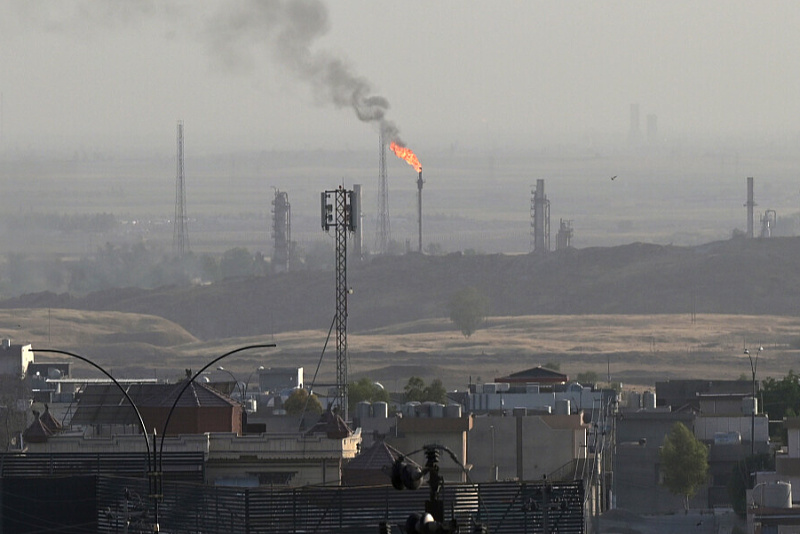
Once bustling Iraqi oil fields are now largely deserted, and ports that teemed with cargo have been reduced to the quiet rhythm of waves. The war in Iran has lasted a month, and workers in Basra province, where nearly all Iraqi oil originates and is exported from, have grown accustomed to rockets flying toward American bases and other strategic targets.
The conflict, which began with U.S.-Israeli strikes, is severely impacting the Iraqi economy. The country relies on oil revenues for about 90% of its budget, and most exports pass through the Strait of Hormuz, a narrow entrance to the Persian Gulf that Iran has almost completely closed to cargo traffic during the war.
Simultaneously, the volume of goods imported into southern Iraqi ports has significantly decreased, and attacks have halted traffic at the border with Iran.
Unlike other war-affected Middle Eastern countries, Iraq simultaneously hosts forces aligned with Iran and significant American interests, making it vulnerable to strikes from both sides.
Since the start of the war, oil production in southern Iraq, where Basra is located, has dropped by more than 70%, and the amount of imported goods arriving at ports has been halved.
Drones and rockets have targeted American companies and military bases, while Iraqi armed groups aligned with Iran have attacked oil fields and energy infrastructure. Many foreign workers have left the country.
According to expert estimates, the Iraqi government could sustain itself without new oil revenues until mid-May, after which it would have to resort to borrowing.
"After that, the government would turn to issuing bonds," says Ahmed Tabaqchali, an expert on the Iraqi economy.
However, he notes, this would not come without consequences.
The closure of Hormuz has forced oil fields in southern Iraq to reduce production and shift focus to domestic needs, while global oil prices have risen. The Zubair oil field in Basra, which previously produced about 400,000 barrels per day, now yields approximately 250,000 barrels, officials report.
The head of the state-owned Basra Oil Company, Bassem Abdul Karim, says Iran has offered assurances that Iraqi oil can safely pass through the strait. However, Iraq lacks its own tanker fleet and depends on chartered ships, so the fate of shipments depends on whether owners consider the risk of sailing through a war zone, and most refuse.
The decline in production at Zubair is part of a broader collapse in Basra. Total oil output in the province has decreased from 3.1 million barrels per day to approximately 900,000, Abdul Karim states.
"Exports are currently completely halted. We are currently considering alternative loading locations, but none are fully operational," he told The Associated Press.