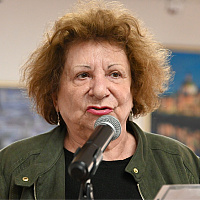
The central part of the project is a time capsule—a symbolic space where citizens will have the opportunity to leave personal records as a testimony of an era. The capsule will be open to the public during the exhibition, from April 6th to 10th, after which it will be sealed and stored. Its contents will be opened and read in ten years, serving as a document of a generation and their perspective on Sarajevo. Shejla Šehabović, director of the Museum of Literature and Performing Arts, which will safeguard the time capsule for the next 10 years, stated that museums have always preserved heritage for future generations. She also noted that in ten years, given the rapid pace of digitization, it might seem strange to come across paper. Dina Krilić, vice president of the "Sevdah Salon Balkan" Association, said it will be interesting to see what this nation thinks today and what they will think in ten years. The event was complemented by a musical performance by Eda and Dina Krilić. Jasna Diklić, who was the first to place her memory in the time capsule, mentioned, among other things, that she is quite skeptical about living to see the capsule opened but believes the idea is excellent. "The idea of archiving certain memories, some sentences that were significant for the connection between us and the city. And I think it’s a very good thriller-like scenario—that in ten years, you take out all those messages and read what we, in our time, thought about your and our city. I think such innovations enrich our city with new ideas, step by step, and we’ll see where it leads, but I believe the journey will be very good, and the maturation of that love between the city and personal feelings for the city is a very, very good path," said Diklić. An exhibition, which serves as a dialogue between contemporary and historical Sarajevo, also opened today at the Museum. The exhibition features photographs by Esad Lukač. In addition to the photo exhibition, the exhibits include items from collections dedicated to prominent figures and institutions of the Bosnian-Herzegovinian cultural scene, including the Karagöz puppet from the works of Rejhan Demirdžić, Boris Smoje’s theater binoculars, a stage photograph from the play "Hamlet" by the National Theater Sarajevo, and a portrait of actress Jolanda Đačić. Citizens who wish to leave their thoughts for future generations can do so at the Museum of Literature and Performing Arts.
Society
At the Museum of Literature and Theater Arts of Bosnia and Herzegovina, the unique project "Sarajevo Time Capsule" has begun.
On the occasion of marking Sarajevo City Day, the project "Sarajevo Time Capsule" will be implemented from today until April 10 at the Museum of Literature and Theater Arts of Bosnia and Herzegovina. It is organized by the "Sevdah Salon Balkan" Association, with the support of the City of Sarajevo.
ingestion