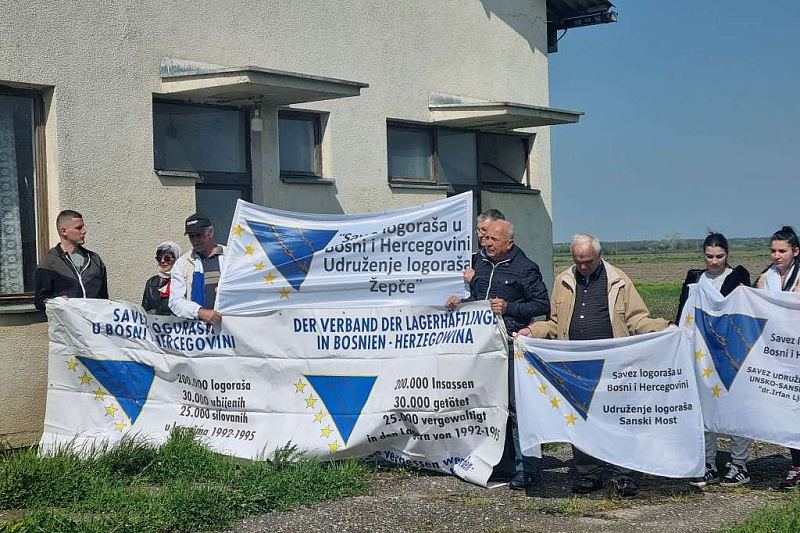
The commemoration was held in the hangars of the former agricultural cooperative, at the site where the Batković camp was established on April 1, 1992, and was not closed until January 1996, as the last camp of its kind in the country. According to available data, around 40,000 civilians, mostly Bosniaks, Croats, and Roma, passed through the camp, while at least 80 prisoners were killed either in the camp itself or during forced labor on the front lines during the aggression against Bosnia and Herzegovina. The President of the Association of Camp Inmates of Bijeljina – Janja, Mehmed Đezić, recalled his personal experience of captivity, stating that he was brought to the camp in October 1994 after being transferred through other camps, where prisoners, he said, were hidden from representatives of the International Red Cross. "I was brought to Batković with a group of about 200 people from Janja. My stay lasted nine months," said Đezić. He emphasized that around 700 residents of Janja passed through the camp, 22 of whom were killed, and expressed dissatisfaction with the fact that, to this day, no one has been held accountable for the crimes committed. "We also filed lawsuits for compensation of non-material damages, but they were rejected, and the prisoners were even charged for court costs," Đezić noted. Former camp inmates also pointed to the difficult social context of their return, highlighting that they encounter individuals who participated in guarding the camp and abusing prisoners on a daily basis. The message from the commemoration was that the truth about the Batković camp must be preserved from oblivion, along with the demand for justice and prosecution of those responsible for the crimes committed. In Janja, the 33rd anniversary of the demolition of the Atik and Džedid mosques was also marked today, as well as 13 years since the construction of the monument to the martyrs and civilian victims of the aggression against Bosnia and Herzegovina.
Society
The first camp for non-Serb population in Bosnia and Herzegovina was opened in Batković near Bijeljina: The 34th anniversary has been marked.
In Batković near Bijeljina, the 34th anniversary of the establishment of the first concentration camp for non-Serb population in Bosnia and Herzegovina was commemorated, organized by the Association of Camp Inmates Bijeljina – Janja and the Majlis of the Islamic Community Janja, as well as the Association of Demobilized Soldiers of the Army of RBiH Bijeljina - Janja.
ingestion