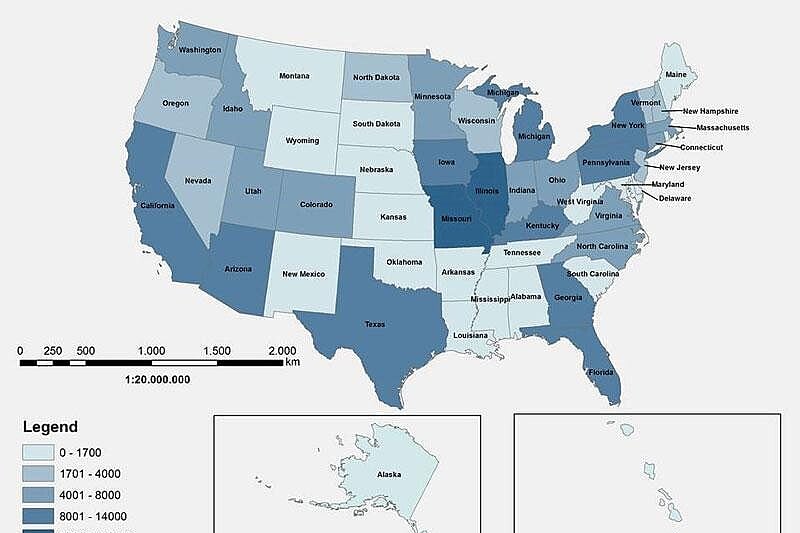
Estimates indicate that approximately 400,000 people of Bosnian and Herzegovinian origin live in the United States and Canada combined. In the United States, according to available data and estimates, between 300,000 and 350,000 people of BiH origin reside, while official statistics record slightly over 100,000 individuals born in our country. The difference arises from the fact that, in a broader sense, second-generation individuals born in the U.S. are also included. The largest concentration of this community is in St. Louis, often described as the biggest center of the Bosnian-Herzegovinian diaspora outside the homeland, with estimates suggesting over 60,000 people of BiH origin live in that city. Significant communities also exist in Chicago, Jacksonville, Utica, Detroit, Phoenix, and New York, with states such as Illinois, New York, Missouri, and Michigan among those with the highest numbers of immigrants from BiH. In Canada, the community is smaller in number but stable and well-integrated. It is estimated that between 40,000 and 45,000 people of Bosnian and Herzegovinian origin live there, while around 38,000 citizens identify as Bosnian. The largest concentration is recorded in Toronto and its surroundings, while Montreal, Calgary, and Edmonton are also important gathering centers for this diaspora. Most BiH citizens in North America arrived during and immediately after the war in the 1990s, primarily as refugees. Although they initially entered the labor market through physical jobs and industry, they relatively quickly achieved economic stability. Over time, many started their own businesses, particularly in the construction, transportation, and hospitality sectors, while the second generation is increasingly present in professions requiring higher education, such as medicine, IT, and engineering. One of the key characteristics of this diaspora is its relatively successful integration into the societies where they live, while simultaneously preserving their cultural and national identity. Cultural centers, religious communities, and associations that bring together people of BiH origin operate in numerous cities, and the Bosnian language continues to be used in everyday communication within the community. Although geographically distant, Bosnians and Herzegovinians in North America remain connected to their homeland through family ties, economic flows, and interest in social and political developments in BiH, making this diaspora an important factor beyond the country's borders.
Society
Over 400,000 people of Bosnian and Herzegovinian origin live in the United States and Canada: They are well integrated and maintain ties with their homeland.
The Bosnian-Herzegovinian diaspora in North America today represents one of the most organized and stable communities of people originating from our country. It is precisely this community that will joyfully welcome our national football team, which will play in the World Cup in America and Canada in June.
ingestion