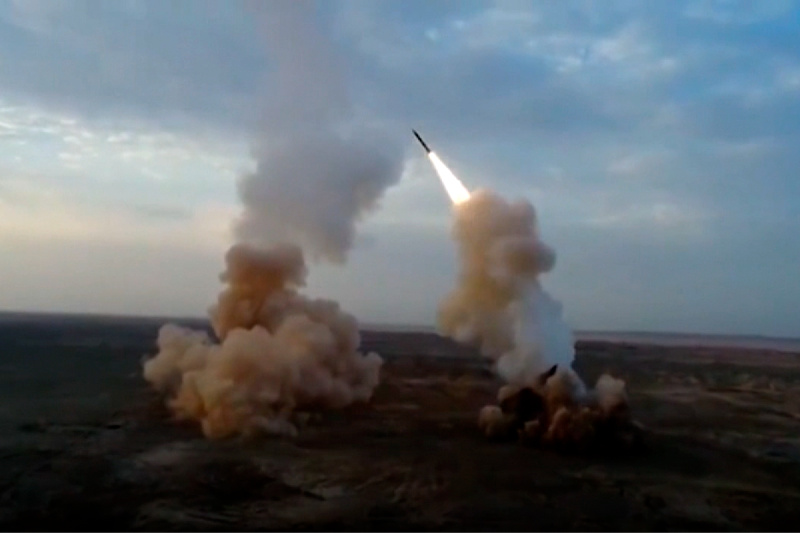
At the same time, it is officially acknowledged that Tehran still retains certain capabilities, whether for retaliation or for its own defense.
General Dan Caine, Chairman of the U.S. Joint Chiefs of Staff, said this week that the U.S. military has struck over 13,000 targets. He cited high percentages of Iranian air defense systems, naval assets, and weapons factories that have been hit or destroyed.
However, the overall figures do not necessarily mean that Iran's military capabilities have been "decimated," as claimed by the President.
Independent data from the Armed Conflict Location & Event Data organization, a U.S.-based group that tracks conflicts worldwide, shows that Iranian strikes have remained at a relatively stable and uninterrupted level from the start of the war on February 28 through Wednesday.
Here is an overview of what the U.S. claims to have targeted, degraded, or what remains for Iran, in numbers:
Caine told reporters at the Pentagon on Wednesday that the U.S. military has conducted attacks on over 1,500 air defense targets, more than 450 ballistic missile storage sites, and 800 one-way attack drone storage sites. "All those systems are gone," he stated.
Defense Secretary Pete Hegseth similarly asserted that "Iran no longer has air defense" and that the U.S. "controls their skies," only to soon after acknowledge that Iran "can still shoot, we are aware of that."
Hegseth later clarified that the Iranians might "have a system here or there," but no longer possess an integrated air defense "network capable of defending their skies."
Neither Caine nor Hegseth explained what the remaining 20% of Iran's air defense looks like, nor which parts of the country have the capacity to carry out the sporadic fire they describe.
Caine also did not provide new details about the weapon Iran used to shoot down a U.S. F-15E Strike Eagle last week. This marked the first time a U.S. military aircraft has been downed during this war, demonstrating that Tehran still has the ability to retaliate despite claims from the Trump administration.
On Monday, Trump described the weapon as a "man-portable, shoulder-fired, guided, heat-seeking missile launcher."
White House Press Secretary Karoline Leavitt told reporters on Wednesday that the Iranian navy has been "completely destroyed."
Caine noted that 150 Iranian ships are "at the bottom of the ocean," but also that only half of the Islamic Revolutionary Guard Corps' small attack boats—vessels used by the regime to harass and swarm warships and merchant vessels in the Strait of Hormuz—have been sunk.
He added that, after more than 700 attacks, the military believes it has destroyed over 95% of Iran's naval mines.
Since the U.S. has not disclosed the size of Iran's pre-war arsenal, it is unknown how many mines constitute the remaining 5%. Semi-official Iranian news agencies published a chart on Thursday suggesting the Revolutionary Guard has laid naval mines in the Strait of Hormuz during the war, a key oil shipping trade route.
The message is likely intended as a form of pressure ahead of negotiations between Iran, Israel, and the United States scheduled for this weekend in Pakistan. Independent analysts note they have not observed changes in commercial traffic through the strait since a fragile ceasefire took effect earlier in the week.
Caine stated on Wednesday that the military has "destroyed Iran's defense industrial base," noting that the U.S. and allies have attacked "roughly 90% of their weapons factories."
He also said that "nearly 80% of Iran's nuclear industrial base has been targeted, further degrading their attempts to obtain nuclear weapons."
While he emphasized that Iran is no longer capable of producing certain components, such as solid-fuel rocket motors, he did not claim that Tehran would be unable to rebuild capabilities or acquire weapons through other means in the future, nor that the factories targeted were completely destroyed or permanently disabled.
Trump himself acknowledged this possibility when he warned other countries against arming Iran.
"Any nation that supplies military weapons to Iran will be immediately subject to a 50% tariff on all goods it sells to the United States, effective immediately," Trump stated in a social media post on Wednesday.
Meanwhile, the Israeli military has emphasized how many drones and missiles it has successfully intercepted before they hit their targets. It reported an interception rate of over 90%, thanks to its air defense systems.
Over decades, Israel has developed a sophisticated system capable of detecting incoming fire and responding only if the projectile is headed toward a populated area or sensitive military or civilian infrastructure.
Israeli leaders stress that the system is not 100% reliable but credit it with preventing significant material damage and countless casualties.