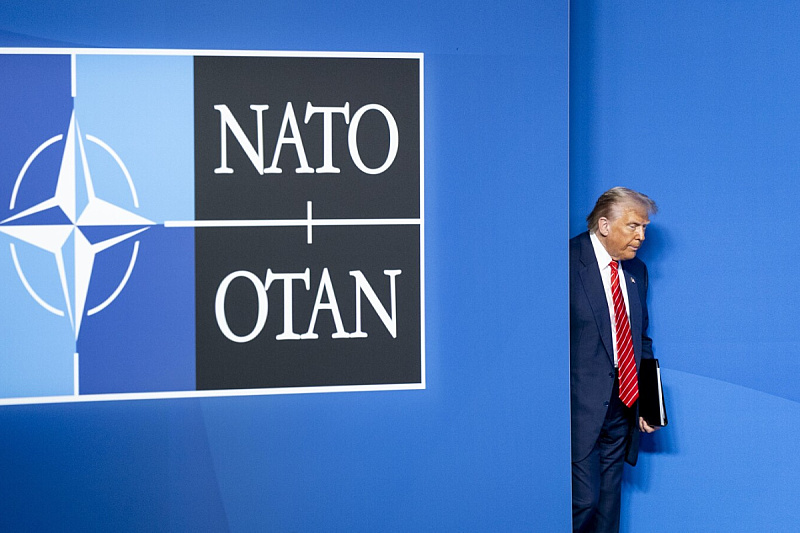
According to officials from the administration cited by this newspaper, the proposal involves withdrawing U.S. troops from Alliance countries deemed "useless" in the military campaign against Iran. These troops would, according to the plan, be stationed in those countries that have provided greater support to U.S. efforts.
This proposal is nevertheless milder than Trump's recent threats of a complete U.S. withdrawal from NATO, a move that legally cannot be made without congressional approval. However, the plan currently circulating in the White House highlights the growing rift between the Trump administration and European allies following the decision to launch the war.
Who loses and who gains from U.S. troops?
Although the White House has not officially commented on the plan, the Wall Street Journal notes that numerous Alliance members have drawn Trump's anger due to their opposition to the war in Iran.
Particular frustrations are directed at Spain, the only NATO country that has not pledged to allocate 5% of GDP to defense and which blocked the use of its airspace by U.S. aircraft involved in operations against Iran. Germany is also under criticism, whose officials have publicly criticized the war, despite the country serving as a key hub for U.S. military operations in the Middle East.
Additionally, Italy briefly blocked the use of a base in Sicily, while France allowed landings at a base in the south of the country only for aircraft not directly participating in attacks on Iran. According to officials, the plan could result in the closure of U.S. bases in Spain or Germany.
On the other hand, countries that could benefit are Poland, Romania, Lithuania, and Greece. These states have some of the highest defense spending rates and were among the first to support the international coalition for monitoring the Strait of Hormuz. Romania, for example, immediately after the outbreak of the war approved requests for the use of its bases by U.S. air forces. The WSJ notes that this move would bring U.S. troops closer to the Russian border, which would certainly provoke a reaction from Moscow.
Europeans in shock: "We weren't even consulted"
NATO Secretary-General Mark Rutte was in Washington on Wednesday for a meeting with Trump. Rutte, who previously managed to dissuade Trump from the bizarre idea of "taking over" Greenland, is now trying to deepen ties and reduce transatlantic tensions.
"It is quite sad that NATO has turned its back on the American people in the last six weeks, while it is the American people who fund their defense," White House spokeswoman Karoline Leavitt stated on Wednesday.
Trump earlier wrote on his social network Truth Social that member states "have done absolutely nothing to help" and added that "the U.S. needs nothing from NATO."
On the other hand, senior European officials defend themselves by claiming they were not consulted in advance about launching the war with Iran, which hindered the coordination of military responses. How chaotic the situation was is also indicated by the fact that two NATO defense ministers, from Estonia and Italy, were stranded in Dubai when the U.S. launched the attack, because the United Arab Emirates closed its commercial airspace.
The war in Iran is just the latest in a series of diplomatic crises since Trump returned to the White House, including disputes over tariffs, negotiations with Vladimir Putin over Ukraine, and renewed disagreements with Denmark. Recall that during his first term in 2020, Trump ordered the withdrawal of about 12,000 troops from Germany, but that decision was reversed by Joe Biden after taking office in 2021.