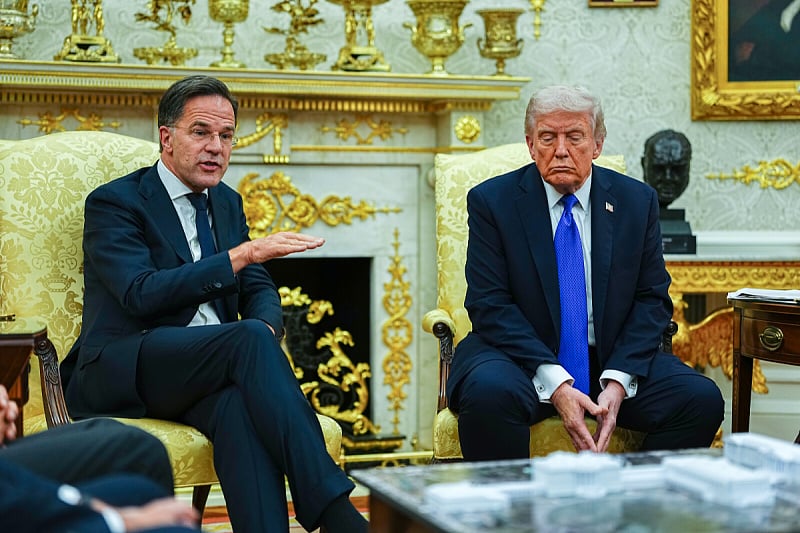
Rutte met with Trump behind closed doors as part of a previously planned visit that quickly turned into a rescue mission, after the U.S. president repeatedly threatened to leave the alliance because countries like Spain and France did not support the U.S.-Israeli conflict with Tehran, which had reached a fragile ceasefire.
According to two European officials and one person familiar with the talks, Trump used the meeting at the White House as an opportunity to express frustration over Europe's refusal to participate in an operation against Iran.
"It went terribly. The conversation turned into a tirade of insults. Trump allegedly threatened almost everything," said the first European official.
That official and the person familiar with the talks noted that Trump also signaled he was considering retaliation options but did not go into details.
The same two individuals, along with a third European official briefed on the meeting, said the U.S. president gave the impression that he wanted concrete actions from allies to reopen the Strait of Hormuz as soon as possible.
However, a White House official said the president made no demands on the alliance during his conversation with Rutte.
"As President Trump said yesterday, NATO was put to the test and it failed. He currently has no expectations of NATO and asked for nothing, although the fact is they benefit much more from the Strait of Hormuz than the U.S.," said the White House official.
After the meeting, the U.S. president publicly criticized NATO allies and revived a campaign idea about annexing Greenland.
NATO spokesperson Allison Hart told Politico that Rutte and Trump had a very open conversation but dismissed claims that it went poorly, calling it constructive.
"I sensed his disappointment that he felt too many allies were not with him," Rutte said at an event after the meeting.
A second European official told Politico that, despite the impression of a tense meeting, Rutte's visit came at the right time because it allowed Trump to "vent." The president's posts on Truth Social after the meeting were general and contained no specific threats against NATO or individual members, the official claimed.
"That is a softening compared to some of his earlier statements. It's still an unstable time, but it's fortunate for the alliance that he was there at this moment," the official told Politico.
For now, NATO countries at the alliance's headquarters in Brussels have not been informed of the details of the meeting, according to two senior alliance diplomats, nor have they begun discussions on deploying military equipment to reopen the strait.
U.S. allies have repeatedly promised to help restore navigation through the Strait of Hormuz, but only once the fighting completely stops.
German Chancellor Friedrich Merz stated on Thursday that he encouraged Trump to seriously continue negotiations to end the war with Iran during a phone call.
"At the same time, I assured him that after a peace agreement, Germany would help ensure freedom of navigation through the Strait of Hormuz, provided there is a mandate and a sustainable plan for it. We do not want this war, which has become a transatlantic test, to further strain relations between the U.S. and their European NATO partners," Merz said.
On Wednesday, France's top military commander, General Fabien Mandon, stated that Paris is considering exclusively defensive military options to assist.
"Last week, we hosted officers from various countries that have decided to participate in this initiative with the goal of restoring maritime navigation. The planning phase is progressing, with the shared objective of enhancing navigation security in this strategic area," he said.
Last week, a coalition of 41 countries led by the United Kingdom supported the idea of new sanctions and additional diplomatic pressure on Iran for closing the key strait but clearly emphasized that it would not militarily intervene while the conflict continues.
When asked if London plans to organize a new meeting, British Defense Minister John Healey told Politico that there is nothing to announce regarding next steps or convening meetings.
During a speech in Washington on Thursday, Rutte defended the allies' response to the war in Iran while trying to reassure the public that the alliance is not threatened.