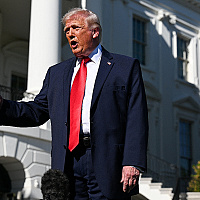
Trump stated that the negotiations have been ongoing for hours and that he receives daily updates on their progress, but he did not want to specify whether an agreement is in sight. However, he emphasized that, as he said, the United States has the advantage regardless of whether an agreement is reached or not.
"We'll see what happens. Maybe they'll reach a deal, maybe they won't. It doesn't matter, from America's perspective, we are winning," Trump said.
Speaking about the military aspect, Trump claimed that U.S. forces have "completely defeated" Iran at sea, stating that a large number of Iranian vessels have been destroyed and that U.S. forces are currently working on clearing mines from sea routes.
He also said that the U.S. ensures free passage at sea for other countries, which he described as "frightened or weak."
He added that NATO, according to his words, has not provided support in this process, while also warning China that it could face consequences if it gets involved in the events.
At the same time, he emphasized that the negotiations with Iran are "very deep," but he personally sees no difference between reaching or not reaching an agreement.
Recall that a new round of negotiations between the United States, Iran, and Pakistan began in Islamabad, where talks have been ongoing for hours without official statements. Although there are no confirmed details, Iranian media report that there are serious obstacles, with claims that the American side has presented "unacceptable demands," especially regarding the strategically important Strait of Hormuz.
Despite tensions, the fact that Washington and Tehran are holding direct talks after almost half a century of hostility represents a significant diplomatic shift. The negotiations are also taking place at a technical level, with the participation of experts, and analysts believe there is room for progress due to the high level of delegations and their willingness to engage in dialogue.
Iran entered the negotiations with expressed distrust after failed previous attempts and recent conflicts, insisting on direct talks with high-level American officials. Although the negotiations are still in the initial phase, diplomats warn that their continuation is important to reduce the risk of a new escalation in an already unstable region.