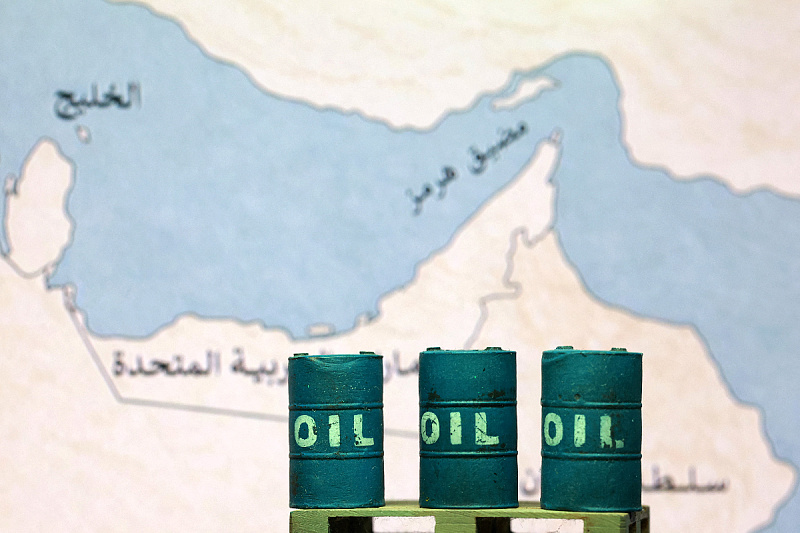
This is also reflected in the messages Trump sends on social media. In just a few days, he stated that America does not use the Strait of Hormuz and that it is an issue for European countries, only to then demand the opening of the strait, accompanied by threats of "hell awaiting Iran."
What changed between Trump's two messages is, above all, the price of oil. The price of American oil surged more than 11% on Thursday, the day after Trump's messages, closing above $111 per barrel—the highest price in the last four years and one of the largest single-day jumps in history.
West Texas Intermediate crude was trading near $100 per barrel just before Trump's speech, whereas before the war began, it was below $70 per barrel.
As CNN notes in its analysis, Trump is correct when he says that the United States relies very little on oil from the Middle East that passes through the Strait of Hormuz.
America receives only about half a million of the 20 million barrels of crude oil that pass through this strait daily—a very small amount that can be replaced with oil from other sources.
However, Trump's latest threat, filled with profanity, underscores, as CNN reports, a bitter truth: the health of the American economy depends far more on the Strait of Hormuz than Trump has been willing to admit.
"The United States has made significant progress over the past fifteen years in restructuring its energy industry, thanks to hydraulic fracturing and horizontal drilling, particularly in the Permian Basin in Texas. America now produces about 22 million barrels of oil per day, twice as much as Saudi Arabia, the second-largest producer, and slightly more than the amount the U.S. consumes daily," the analysis states.
The United States still imports more than six million barrels of crude oil per day, roughly one-third of its consumption. Additionally, the U.S. exports nearly four million barrels per day.
The reason is that not all oil is the same: America produces light, sweet crude oil, which is excellent for gasoline production but poor for heating, asphalt, and diesel, among other heavier derivatives. Therefore, the U.S. must import oil from regions that produce heavy, sour crude oil, including Venezuela and the Middle East.
Moreover, the oil market is global. When supply is reduced in one region, it affects all locations. During shortages, oil importers compete for available barrels, driving up prices for those who need it most, noted Dan Pickering, founder and chief investment officer at Pickering Energy Partners.
Thus, the United States has been, and likely will continue to be, well-supplied with oil during the war with Iran. That is not the main issue. The problem is that America is not insulated from price shocks in the global oil market.
High energy prices are an obvious consequence of the American war and the effective closure of the Strait of Hormuz. Crude oil prices remained high on Monday following Trump's threat to destroy Iranian power plants and bridges. Gasoline prices in the U.S. rose to an average of $4.11 per gallon, or slightly more than one dollar per liter.
These high oil and gasoline prices are already impacting the American economy. Many middle- and lower-income Americans, already strained by high prices, are struggling with expensive fuel, and some small businesses unable to further raise prices face tough decisions regarding employment.
A bigger problem could arise if high prices destroy demand for gasoline and oil. Prices might fall, but if oil and gasoline become too expensive for Americans to fill their cars or fly, it could create significant problems for the economy.
Wall Street analysts estimate that every $10 increase in oil prices per barrel reduces the gross domestic product, the broadest measure of the U.S. economy, by between 0.1 and 0.4 percentage points.
Thus, the current $40 increase per barrel could reduce GDP by about one percentage point. This is not negligible but not enough to seriously disrupt the economy.
However, the situation could quickly worsen if prices spike sharply. And oil is not the only factor: everything delivered by truck will become more expensive due to rising diesel prices. Additionally, a range of other imports through the strait, including aluminum, helium, and fertilizer, among other products, will raise the prices of construction materials, microchips, and food.
Annual consumer inflation for March is expected to jump to 3.5%, completely offsetting last year's average wage growth for American workers.
"The U.S. economy can absorb the shock of oil above $100 per barrel for a certain period. But if the price rises to $150 or $200 per barrel, that's a different story," said Joe Brusuelas, chief economist at RSM US.
This could be a significant factor in Trump's renewed concern for the Strait of Hormuz. Trump has spoken contradictorily about the strait since the war began. His administration has promised naval escorts for tankers and insurance for ships that maritime insurers have stopped covering.
He also said that tankers should show courage and sail through the strait, and that countries more dependent on Middle Eastern oil should help open the strait themselves.
Trump's shifting rhetoric from day to day has caused oil prices to spike and fall, but prices have generally risen as it becomes clear that Iran holds the cards in this strait, and an American exit from the war may not reopen the key passage for oil tankers.
Traders became concerned late last week as Trump did not provide a strategy for exiting the war with Iran, fearing that his threats of escalation could further disrupt crude oil supply.
Iran, on the other hand, has said it would charge fees for safe passage through the strait. Many Gulf countries are likely to refuse to pay this fee. Even a partially open strait would leave the world short of between 4.4 and 8 million barrels per day, according to Anthony Yuen, global energy strategist at Citi Bank.