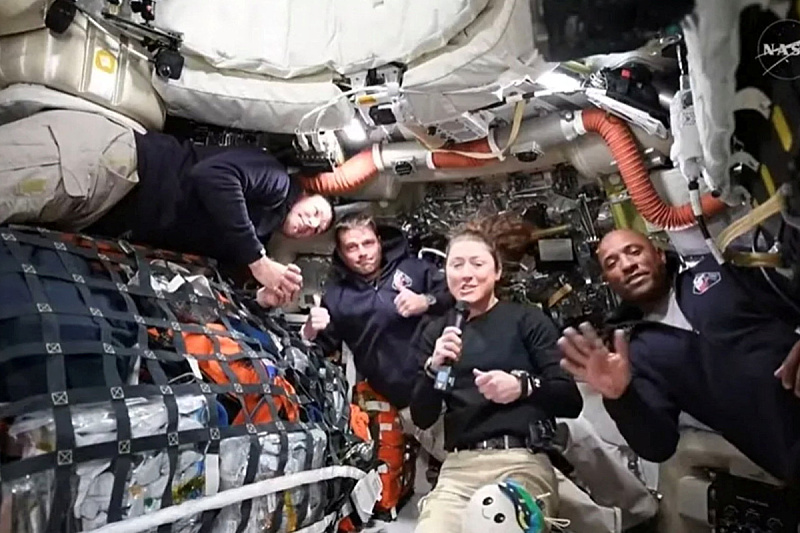
When the astronauts pass behind the Moon around 23:47 British time on Monday, the radio and laser signals that enable communication between the spacecraft and Earth will be blocked by the Moon itself.
For about 40 minutes, the four astronauts will be completely alone, with no way to contact mission control in Houston.
Artemis mission pilot Victor Glover told the BBC that he hopes the world will use that time to come together.
"When we are behind the Moon, out of contact with anyone, let's use it as an opportunity. Let's pray, hope, send good thoughts and feelings to re-establish contact with the crew," he said before the mission.
On Earth, this communication blackout will be a tense period for those responsible for maintaining contact with the spacecraft.
At the Goonhilly ground station in Cornwall, southwest England, a massive antenna collects signals from the Orion capsule, precisely determines its position throughout the journey, and sends that information back to NASA headquarters.
"This is the first time we are tracking a spacecraft with a human crew. We will be a bit nervous when it goes behind the Moon, and then we will be very excited when we see it again, because we will know everyone is safe," said Matt Cosby, Goonhilly's chief technology officer.
However, there is hope that such communication interruptions could soon become a thing of the past. Cosby says this will be crucial as NASA and other space agencies around the world begin building a base on the Moon and intensify further exploration.
"For a sustainable presence on the Moon, full communication is needed, 24 hours a day, even on its far side, because that will also want to be explored," he said.
Programs like Moonlight, led by the European Space Agency, plan to launch a network of satellites around the Moon to ensure continuous and reliable communication coverage in the future.
For the Artemis mission astronauts, the time without contact with Earth will allow them to focus all their attention on the Moon.
During this "darkness," they will dedicate themselves to observation, taking photographs, studying the Moon's geology, and simply enjoying its grandeur.
When they emerge from the Moon's shadow and the signal is re-established, the world will collectively breathe a sigh of relief.
And the astronauts making history will be able to share their incredible views with everyone on Earth.