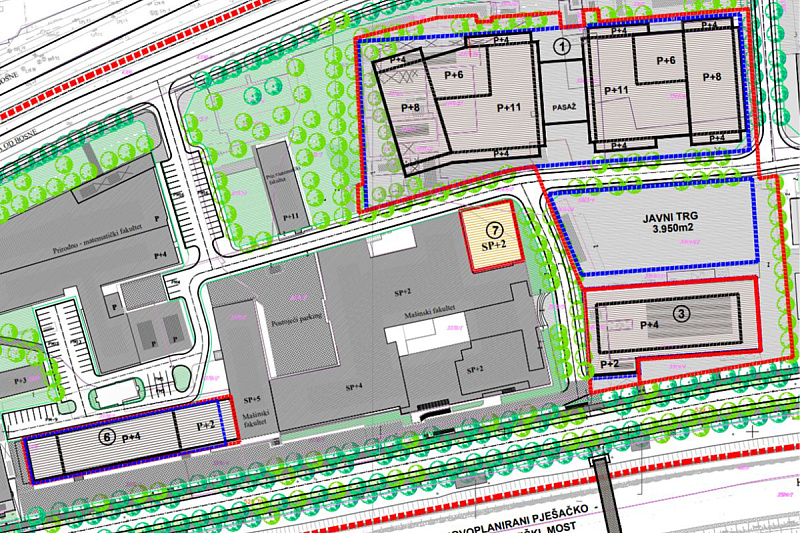
The regulatory plan "Quadrant C – Marijin Dvor," covering approximately 14.6 hectares in the central zone of Sarajevo, envisions intensive construction of business-residential buildings, the Ars Aevi Museum, new traffic routes, and public areas. The plan's goal is to transform the space into an "open urban quadrant" accessible to all citizens.
However, precisely this concept has encountered strong resistance from the University of Sarajevo, particularly from the Faculty of Natural Sciences and Mathematics and the Faculty of Mechanical Engineering. As Klix.ba learns, an extraordinary session of the UNSA Senate will be held on Wednesday regarding this matter.
Fear of Traffic Roads and "Splitting" of Land
The biggest objection relates to the planned traffic routes and parking lots on University land. UNSA warns that new roads would pass between faculty buildings, thereby disrupting the functional integrity of the campus and increasing safety risks for over 1,500 students and staff who are present in that area daily.
Additionally, the Faculty of Mechanical Engineering points out that the plan ignores existing infrastructure, such as transformer stations and boiler rooms, and that certain parts of the buildings are incorrectly marked as public areas. The planned access routes are also problematic, as they could hinder entry into the buildings, including access for emergency services.
The University also claims it was not adequately involved in the planning process and states that the proposed solutions undermine the concept of the campus as a pedestrian and educational zone.
According to the University, these interventions are not merely technical in nature. They believe it would permanently alter the space, cut through existing functional units, and seriously compromise conditions for teaching and scientific research.
Particularly contentious is the so-called "service traffic route," which the University claims would, in practice, function as a public road with heavy traffic. Its introduction through the campus area, used daily by thousands of students and employees, is assessed as a serious safety risk.
The University also emphasizes that it was not adequately included in the planning process, despite the fact that it concerns land and buildings of public importance. Such an approach is considered contrary to the principles of participatory urbanism and existing legal procedures.
Additional remarks come from the Faculty of Mechanical Engineering, which warns of specific technical shortcomings in the plan—including the omission of key infrastructure like transformer stations and boiler rooms, incorrectly marked areas, and the obstruction of access to the faculty's main entrances. A particular problem is the closure of access from Wilson's Promenade, which would make it difficult for students, staff, and emergency services to enter.
Although certain technical errors have been acknowledged, most of the University's key objections have been rejected with the explanation that the plan follows valid urban planning documents and the city's strategic development guidelines.
The University states that it will insist on changes to the plan and, if necessary, take legal steps to protect its space and ensure campus development in line with the public interest.
Dispute Over Greenery and Parking
The regulatory plan "Quadrant C – Marijin Dvor" envisions significant changes regarding green areas and stationary traffic, which has drawn additional criticism from professional and academic circles.
According to the plan, part of the existing green areas would be repurposed for the construction of new buildings and accompanying infrastructure, including traffic routes and parking lots. The University of Sarajevo warns that this reduces the space intended for greenery and undermines the concept of the campus as an open and pedestrian zone.
Special focus is on so-called stationary traffic, i.e., parking. The plan envisions new parking capacities, including underground garages, as well as parking adjacent to the faculty buildings themselves. The University points out that such solutions are planned on their land and could further burden the space and jeopardize the safety and functionality of the campus.
These remarks further highlight the conflict between planned urban development and the preservation of existing public and educational spaces in the center of Sarajevo.
The proposal for amendments to the Regulatory Plan "Quadrant C" will be before the city councilors by the end of this month.
What the Amendment to the RP "Quadrant C" Envisions
The adoption of this Regulatory Plan opens the way for the realization of a series of large projects that will completely transform this part of Sarajevo.
Among other things, plans include the expansion of the Faculty of Mechanical Engineering complex, the addition to the Importanne business-residential complex (a new 12-story wing), the construction of the Ars Aevi Museum of Contemporary Art, the construction of the Embassy of the Kingdom of Saudi Arabia, the realization of the WTC Sarajevo business complex, a new business building along Wilson's Promenade on the site of existing hospitality facilities, and the construction of an additional pedestrian bridge over the Miljacka River near the Faculty of Mechanical Engineering.
The plan also envisions better connectivity of the University Campus through pedestrian walkways.