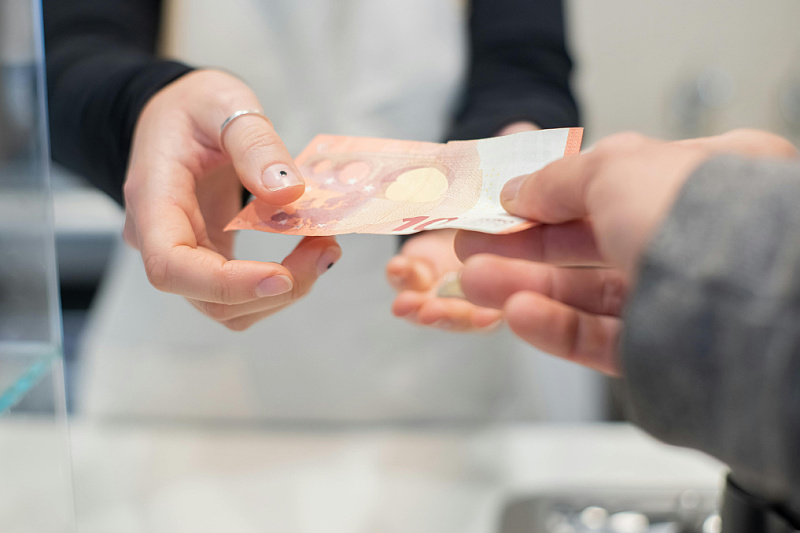
We took the same amount - 200 euros, and tried to send it in three different ways. We tracked four things: how much it costs to send, how much money actually arrives, how long it takes, and how simple the entire process is.
Money Transfer Networks Traditional money transfer networks like Western Union have been synonymous with sending money home for generations of the Bosnian diaspora. Their network is huge, recognizable, and available almost everywhere in Europe. However, the price of that recognizability is not small.
The fee for sending 200 euros from, say, Austria or Germany to Bosnia and Herzegovina ranges between 4 and 12 euros, depending on the payment method and location. Additionally, the exchange rate they apply is often less favorable than the market rate, meaning the recipient receives less than the nominal transaction amount shows.
The total cost of the transaction, taking into account both the fee and the exchange rate difference, can easily amount to 10 to 15 euros for every 200 sent. Annually, for someone sending money once a month, that's 120 to 180 euros that do not reach home.
The money is available to the recipient within a few minutes to a few hours or even days, and users can withdraw cash at counters.
Bank Transfer Bank transfers seem like a "safe" and "serious" choice, but in practice, they come with their own frustrations.
SEPA transfers within the eurozone are technically free or cheap, but Bosnia and Herzegovina is not in the SEPA zone. This means that sending money from the EU to Bosnia and Herzegovina is treated as an international transfer with fees that vary from bank to bank, but are rarely below 5 to 10 euros per transaction. Some banks charge up to 25 euros for an international transfer, especially for smaller amounts.
Besides fees, there is also waiting. A standard international bank transfer takes one to three business days. On weekends or holidays, it takes even longer. For someone who needs money urgently, this can be too long.
The process also requires the recipient's IBAN, the bank's BIC/SWIFT code, and sometimes additional documentation for larger amounts. It is not particularly complicated, but it is not intuitive either, especially for older users.
Digital Wallets Digital wallets, or money-sending apps, are becoming increasingly popular. One of them is Aircash, which has gained a significant number of users across Europe, including Bosnia and Herzegovina, and particularly the Bosnian diaspora in the EU, in recent years.
Sending money works like this: the sender from the EU opens the Aircash app, tops up their account via card or cash, enters the amount and the recipient's phone number in Bosnia and Herzegovina, and confirms the transaction. The money arrives in the recipient's account within seconds, regardless of the time of day, day of the week, or holidays.
The fee for sending is one percent of the amount sent. For 200 euros, that's two euros, which is significantly less than with transfer networks or banks, and without hidden deductions through exchange rate differences. The recipient receives the amount intended for them, not what remains after a series of fees and conversions.
The only requirement on both sides is an active Aircash account, which can be opened for free through the app in a few minutes, without visiting a branch. Aircash operates with licenses from the relevant authorities in the EU and Bosnia and Herzegovina, so data and money are secure.
Users in Bosnia and Herzegovina who receive money through Aircash can put it to immediate use via the Aircash Mastercard - a physical payment card directly linked to the Aircash account. The card is accepted everywhere the Mastercard network exists, both online and for in-store purchases. There is no annual or monthly fee, no commission on payments, and all transactions are visible in real-time through the app. For those who want better control over daily spending, especially during times when living costs are rising, this is not a negligible detail.
The card can be purchased throughout Bosnia and Herzegovina at sales points of iNovine, INA, Energopetrol, Petrol, Nestropetrol, Nešković, or SuperPetrol. Additionally, money from Aircash can be withdrawn at all ATMs in Bosnia and Herzegovina without a fee.
Each of these three methods has its own logic. Western Union offers recognizability but also higher fees. Bank transfers seem safe and familiar. However, when considering costs, speed, and simplicity - a digital wallet like Aircash offers a combination that the other two cannot.
For someone who sends money regularly, the difference in fees is not a negligible item; over the year, it turns into an amount that could go directly to the household account, not to fees.