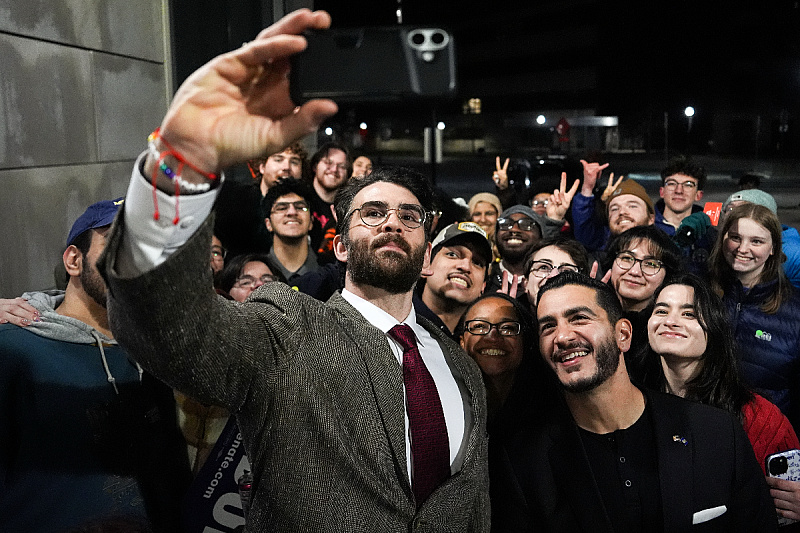
Debbie Dingell, a longtime Democratic congresswoman, came to watch the performance of progressive U.S. Senate candidate Abdul El-Sayed, who held a rally with Hasan Piker, a popular but controversial online streamer.
For years, Dingell has been something of an early warning system for her party: she warned that Republican presidential candidate Donald Trump was on track to win Michigan in 2016 and 2024.
Now, she was once again assessing how the political landscape is shifting, and something particularly caught her attention.
"Honestly, I haven’t seen this many people outside an event yet this year," said Dingell, whose district includes Ann Arbor and who emphasized that her attendance did not imply endorsement.
The line, mostly composed of young people, stretched from the entrance to the street, with hundreds waiting in the chilly evening air on Tuesday. Some carried backpacks after classes, while others traveled from farther away.
Although they came to see the progressive candidate, those present did not fit into clear ideological boxes. Instead, they shared a common dissatisfaction with both major political parties. Their frustration echoed the anger that has characterized modern American politics for years, and now, ahead of the midterm elections that will decide control of Congress, it is clearly simmering in a new generation.
Liam Koenig was in third grade when Trump was first elected president—a moment that shaped his generation’s political understanding.
"Everything just became more flammable," he said.
Today, he is a high school senior in Oakland County, long considered Michigan’s political barometer. Koenig describes an era of constant conflict and anxiety. The mood among his peers, he says, is often gloomy and frustrated.
"I think many of us have lost hope for any tangible change," he said.
According to a February AP-NORC poll, younger American adults are more likely than older generations to hold negative views of both the Republican and Democratic parties.
Still, that dissatisfaction hasn’t turned Koenig away from politics. He waited for hours to see El-Sayed. He described the campaign as something different from what he was used to, more akin to Zohran Mamdani’s successful run for New York City Council. That’s the kind of energy he wants to see in Michigan.
"You’re not going to get people out if everything stays the same," Koenig said.
Karol Molina, an artist who recently moved from New York, says that upon arriving in Michigan, she looked for a candidate in the mold of Mamdani. She settled on El-Sayed, who is facing Congresswoman Haley Stevens and State Senator Mallory McMorrow in the Democratic primary.
"We want to be able to live and, like, afford a life without constantly surviving day to day," she said.
Molina sought a sharp break from the past.
"I think the Democratic Party is losing because it’s not listening to what people really want," she said. "They’re trying to hold onto the party that existed before Donald Trump. And that party no longer exists."
Ethan Schneider, a junior at the University of Michigan, describes today’s politics as "kind of unserious."
"It’s hard to stay positive or not become bitter at such a young age," Schneider said.
He notes that two years ago, he voted for Democrat Kamala Harris, but like many who stood in line to see Piker and El-Sayed, he is highly critical of her and her party.
"I hate them," he says of the Democrats. "They seem completely complicit in all the problems we have now. If they’re not complicit, then they’re just not doing anything."
According to a recent Gallup poll, younger generations are far more likely to reject both parties. More than half of Gen Z and Millennials identify as politically independent, while most older generations still align with a party.
The Gallup poll showed that this growing group of independents is largely motivated by dissatisfaction with the party in power—a dynamic that could benefit Democrats this year but does not guarantee long-term loyalty.
Jacob Abbott, an undergraduate student at the University of Michigan, says he feels the Democratic Party has shifted toward "corporate interest politics."
He dismissed concerns about El-Sayed’s decision to campaign alongside Piker. The 34-year-old streamer has 3.1 million followers on Twitch and 1.8 million on YouTube and has previously stated that "Hamas is a thousand times better" than Israel, described some Orthodox Jews as "inbred," and claimed that "America deserved 9/11."
For Abbott, that controversy only highlights a broader gap in American politics—a lack of people who can capture attention and speak to citizens’ frustrations, even if they are not flawless.
"Is Hasan perfect? Probably not," Abbott said. "But he’s a lot better than anything the Democratic Party has offered as an alternative so far."
Over decades in politics, Dingell has seen long lines and packed halls before. At this rally with El-Sayed and Piker, she was trying to gauge whether there was something more lasting here.
After all, progressive candidates often generate significant excitement but fail to translate it into electoral victories. El-Sayed himself finished far behind the winner in the 2018 Democratic primary for Michigan governor. Additionally, independent Vermont Senator Bernie Sanders, a leading figure in the progressive movement, was twice defeated in the Democratic presidential primary.
However, some Democrats argue this moment could be different, pointing to recent elections where Mamdani won in New York and Analilia Mejia secured a narrow Democratic primary victory in a New Jersey House special election.
"Wherever there is a progressive, they should run," said Pennsylvania Congresswoman Summer Lee, who also appeared at the rally with El-Sayed.
"Every year, in every race," she added. "We might not win, but we have to raise the question every time."
Dingell says she will be watching closely to see what follows.
"Is this just something young people are having fun with, or will they actually connect and turn it into something more?" she asked.