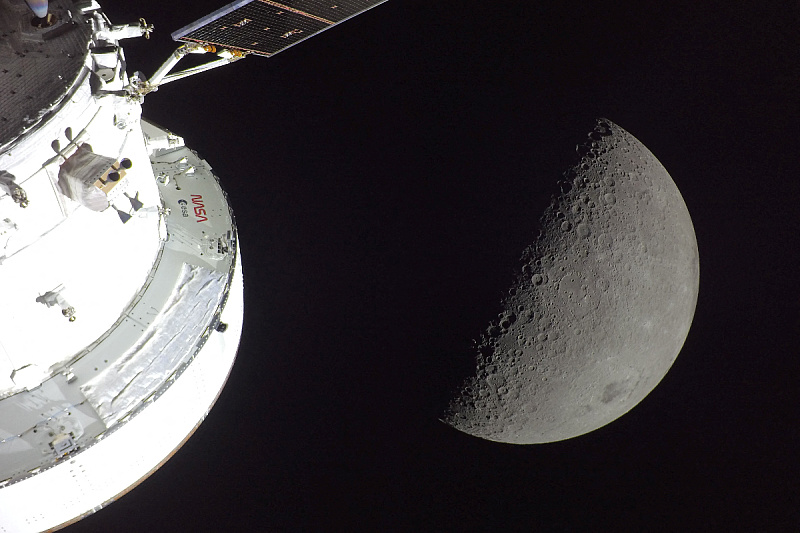
The four-member crew of the Orion spacecraft embarked on a major mission from Cape Canaveral, Florida, on April 1, involving a journey around the Moon for the first time in 50 years. They orbited Earth twice before setting off on a rare trip around the far side of the Moon, venturing deeper into space than any astronaut before.
During their journey, they sent back new and never-before-seen photos from space, with the world's eyes particularly focused on NASA's live broadcast as the crew flew behind the dark side of the Moon.
In the end, they successfully returned to Earth, demonstrating that longer crewed space travel is definitely possible. This mission was a crucial hardware test for the planned lunar landing attempt later this decade, which would be the first landing on the lunar surface since Apollo 17 in late 1972.
Over the 10-day journey, navigation was checked, life support systems were tested, and astronauts and mission members practiced procedures in case of malfunctions. They performed a free-return trajectory around the Moon, piloted the spacecraft manually, and simulated situations such as communication loss and system failures.
NASA aims to achieve a crewed Moon landing before China, which plans to send its own crew around 2030. The agency's broader goal is to establish a long-term presence on the Moon as a stepping stone for potential human exploration of Mars and the construction of planned bases on that planet.
Artemis III is the next space mission, with the announcement of its crew names expected soon. This mission is planned for next year and involves a test docking of private lunar landers with the Orion spacecraft in Earth's orbit. During this, systems necessary for a lunar landing will be tested.
Following that, NASA is expected to attempt landing humans on the lunar surface, which could occur in the Artemis IV mission. However, it is not entirely certain that this will happen during Artemis IV, as that mission might be limited to the Lunar Gateway space station orbiting the Moon and testing capabilities for long-term stays in lunar orbit.