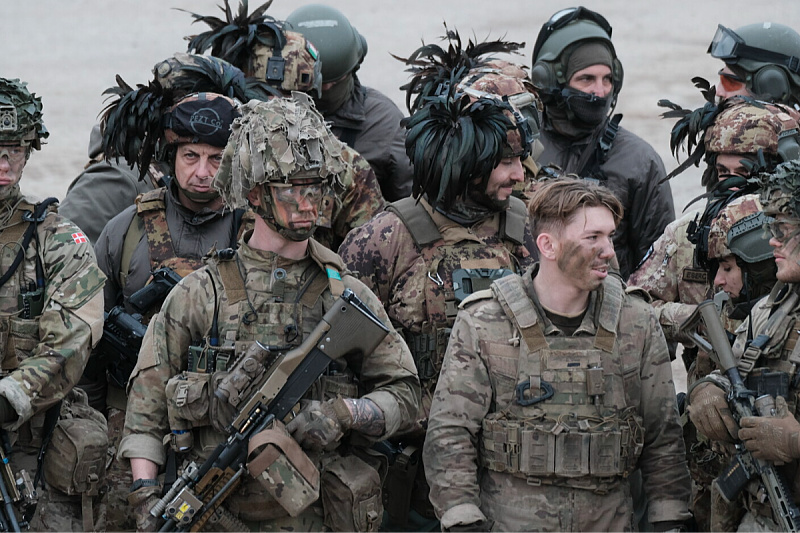
The plan, which some officials already informally call the "European NATO," has gained strong momentum after receiving approval from Germany, a country long opposed to the idea of independent European military action. Officials working on these plans aim to place more Europeans in key command roles within the alliance and supplement U.S. military capabilities with their own. According to the WSJ, these plans are currently being developed informally, through discussions on the sidelines and working dinners in NATO circles.
The goal is not to create a rival to the current alliance but to preserve deterrence against Russia, operational continuity, and nuclear credibility, even in a scenario where Washington withdraws its forces or refuses to defend Europe—something President Donald Trump has already threatened.
The plans, conceived last year, reflect Europe's deep concern about U.S. reliability. The situation escalated after Trump threatened to take Greenland from Denmark and gained further urgency due to Europe's refusal to support the U.S. war in Iran.
A key driver of these changes is a major political shift in Berlin. For decades, Germany resisted calls, largely led by France, for greater European sovereignty in defense, preferring America as the ultimate security guarantor. However, according to WSJ sources, that paradigm is now changing under the leadership of German Chancellor Friedrich Merz, due to serious doubts about U.S. reliability during Trump's tenure and beyond.
Merz began reconsidering long-held positions after concluding that Trump is willing to abandon Ukraine and that U.S. policy within NATO is no longer guided by clear values. German Defense Minister Boris Pistorius emphasized that NATO remains "irreplaceable" but added: "It is clear that we Europeans must take on more responsibility for our defense, and that is exactly what we are doing. NATO must become more European to remain transatlantic."
Trump’s Threats and Europe’s Response
Europeans are now trying to take on some of the burden Trump has long demanded. NATO Secretary-General Mark Rutte recently stated that the alliance will be "more European-led."
However, the difference is that Europeans are now taking steps on their own initiative, spurred by Trump's growing hostility rather than American encouragement. Trump recently called European allies "cowards" and NATO a "paper tiger," adding that "Russian President Vladimir Putin knows it too."
Finnish President Alexander Stubb, one of the few European leaders with close ties to Trump and the head of the country with the longest border with Russia, confirmed that the burden-shifting process is underway. After Trump threatened to leave NATO over a lack of support for his campaign in Iran, Stubb immediately called him to inform him of European plans.
"The basic message to our American friends is that, after all these decades, it is time for Europe to take more responsibility for its own security and defense," Stubb told the WSJ, adding that it is crucial this process happens in a controlled manner, not through a sudden U.S. withdrawal.
Mandatory Military Service and Arms Production
Given that NATO’s command structure has been built around U.S. leadership for decades—from logistics and intelligence to the supreme command itself—the challenges are immense.
According to the Wall Street Journal, only after Berlin’s shift in stance did practical military issues begin to be addressed: who will lead NATO’s air and missile defense, who will secure reinforcement corridors to Poland and the Baltics, and who will manage logistics networks if U.S. officers withdraw.
A key aspect for the plan’s success is the reinstatement of mandatory military service, which many countries abolished after the Cold War. European officials also want to accelerate the production of vital military equipment, including anti-submarine warfare, space capabilities, and aerial refueling systems. An example of this new initiative is the recent agreement between Germany and the UK to jointly develop cruise and hypersonic missiles.
The Nuclear Umbrella: The Biggest Hurdle
Although Europeans are taking on more command roles and leading large military exercises, particularly in the Nordic region, the biggest gaps remain in intelligence and nuclear deterrence.
European officials acknowledge that no troop redeployment can quickly replace U.S. satellites and missile warning systems. This puts pressure on France and the UK to expand their nuclear and intelligence roles. After the Greenland crisis, Chancellor Merz and French President Emmanuel Macron opened talks on whether French nuclear deterrence could be extended to protect other European nations, including Germany.
That the Greenland issue was indeed a turning point was confirmed by Trump himself when explaining his threat to leave NATO: "It all started, if you want to know the truth, with Greenland. We want Greenland. They don’t want to give it to us, and I said, 'Okay, goodbye.'"
In response to this statement, Polish Deputy Prime Minister Radosław Sikorski briefly replied on social media: "Noted."