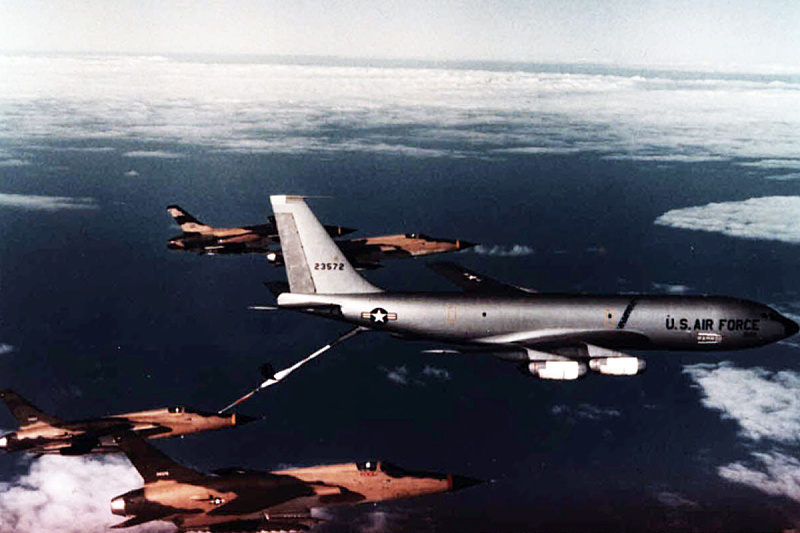
Due to this deficiency, U.S. military crews are forced to use civilian equipment, which they must shut down for security reasons when near combat zones, leading to catastrophic consequences. While all six crew members lost their lives in the wreckage of one U.S. KC-135, another aircraft (KC-135R), which had half of its vertical stabilizer torn off in a collision, miraculously managed to reach the civilian Ben Gurion Airport in Tel Aviv. This damaged aircraft, with registration number 59-1444 (indicating it was manufactured as early as 1959), was previously recorded on radar flying from Tel Aviv toward Iran, after which its transponder was turned off. Several hours later, it sent a distress signal from Tel Aviv. Another aircraft from this incident was recorded flying from Israel to Jordan.
Near Miss with a Passenger Aircraft The shutdown of transponders (identification devices) was also recorded during a December incident near the coast of Venezuela, as previously reported by CNN. On that occasion, a JetBlue passenger aircraft flying from Curaçao to New York nearly collided with this U.S. military tanker. Air traffic controllers confirmed they had to urgently abort the passenger aircraft’s ascent because a U.S. Air Force tanker with its transponder turned off appeared directly in front of it, completely invisible to civilian radars.
Former Air Mobility Command (AMC) commander Jacqueline Van Ovost confirmed to Defense One the practice of turning off transponders, emphasizing that crews in combat zones must act differently than in peacetime. "You don’t want to reveal your position as you would under normal conditions when in contact with air traffic control. In theory, you’d like to have your lights on and radar active so everyone can see you. However, when you’re near ‘bad guys’ territory, you don’t want to be a target, so you simply turn off the equipment," she explained. She warned that most communication devices in these tankers are not designed for modern real-time battlefield tracking (where friendly and enemy forces are clearly distinguished).
Military Accused of "Deplorable Neglect" The Air Mobility Command (AMC) has been warning about this issue for years. Acting AMC commander Reba Sonkiss last month accused the Air Force leadership of "deplorable neglect" in an interview with Air And Space Forces Magazine, highlighting the failure to invest in communication equipment. The modernization program (RTIC) began only a year ago. Currently, out of nearly 400 KC-135 aircraft, more than half are still not equipped with the critical Link16 data link.
Former AMC chief Mike Minihan was particularly sharp on LinkedIn after the tragic collision: "We should not put airlift crews, especially tanker crews, in a position where they have to choose in the midst of combat: whether everyone, including the enemy, sees them, or no one, including allies and civilian aircraft, sees them."
The root of the problem lies in the delayed modernization of the military fleet. The last KC-135 models were produced as far back as the 1960s. Although their replacement has been planned for years, tenders have been canceled. When Boeing finally won the tender for new tankers in 2011, deliveries were consistently delayed due to production quality issues. The result of this bureaucracy and delay is staggering: the U.S. Air Force now estimates that the ancient KC-135 tankers will have to remain in service at least until 2050, with the possibility of further extension.