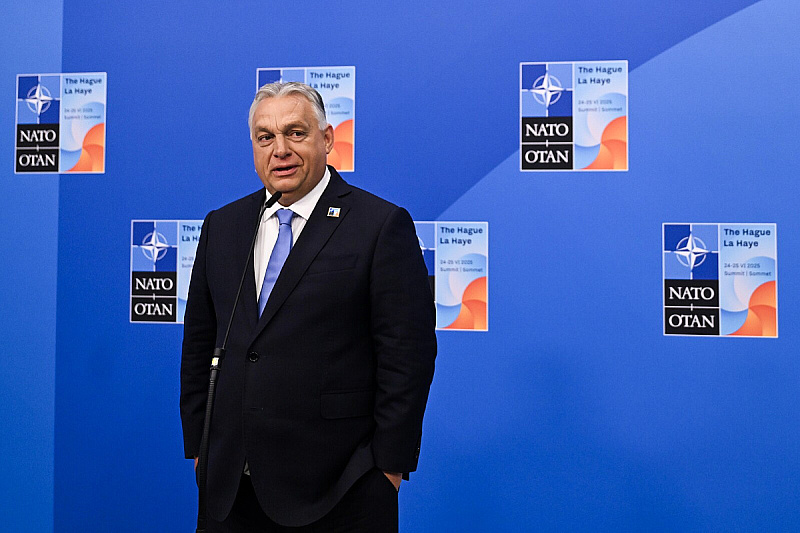
Magyar and his Tisza party secured a two-thirds majority using a system that Orban spent 15 years building to keep himself in power. However, the main story of the Hungarian election will not be Orban's collapse, nor Magyar's victory, but the death of the idea that a "soft dictatorship" can be built and sustained, which is the dream of right-wingers worldwide. The evolution of dictatorship died one night in Budapest.
Dictatorship, as a political system, is an idea that evolved with Orban. This system, as such, is extremely difficult to defend as a legitimate way of governance, which is why a revolution was needed. Dictatorship is associated with mass repression, personality cult building, killing and persecution of all who think differently, and many other things by which dictatorial regimes, from South America to Asia, have been recognizable.
Orban, on the other hand, during his 16 years of rule, implemented what could be called a "soft dictatorship," because the things recognizable in classic dictatorships were not present to a large extent in Orban's Hungary. Of course, saying that Orban's regime was open is far from the truth, but it was largely free compared to similar regimes in Russia and Belarus.
Political parties were not suppressed; most of their members had the right to run and campaign, and there was (albeit limited) space for media that did not repeat the claims of official Budapest. Of course, such a situation existed in private media, while public broadcasters worked exclusively in favor of Orban's regime.
Nevertheless, Orban's associates massively bought media that could once be described as "free" or "independent." Additionally, while the existence of opposition parties was allowed, they were systematically smothered by the media and had no opportunity to address citizens.
If they passed all these restrictions, which largely did not cross the line into open violence, they would face Fidesz in a system specifically designed so that the party with slightly more citizen trust had absolute power. Until Magyar appeared, no party had the strength to resist this, while Orban, unlike open dictators like Alexander Lukashenko and Vladimir Putin, had relatively clean hands.
The summary of this rule is "soft dictatorship," i.e., an apparently free system where the opposition started the electoral race kilometers behind Fidesz.
The dream of the world's right-wingers—a dictatorship that isn't one. Because of the way Orban ruled, he became a global star for right-wingers who dreamed of a system of absolute power without being legitimately accused of the worst aspects of a dictatorial system.
Simply put, Orban gave his like-minded individuals a roadmap to a beautified version of dictatorship that still offers the possibility of absolute power but can be tolerated due to the lack of the most aggressive aspects of this system. His changes to the electoral system, taking over 90% of the country's media landscape, destroying the opposition without an open ban, and controlling every aspect of Hungarian citizens' lives were a dream for right-wingers in Europe, who hoped to achieve similar power.
However, the fact that Tisza managed to achieve victory over Fidesz showed one major flaw of such a system—no electoral system, no matter how carefully built to defend one regime, can guarantee survival in power. Magyar gained the support of just over 50% of Hungarian citizens, which in a "normal" democratic country would be enough to form a government but not to change the system itself.
However, Orban's system allowed him to have as many as 138 seats in the future parliament, i.e., the two-thirds majority needed to amend the constitution, which Orban often did during his 16-year rule.
Right-wingers are not going anywhere, but they have suffered a serious blow. Orban's defeat as a symbol of hope that right-wingers can come to power and stay in power by following the principles he established is not a collapse for right-wingers, who will continue to be an important force worldwide.
However, with the fall of the person who gave them a roadmap for action, along with a certain defeat of Republicans tied to the MAGA (Make America Great Again) cult of U.S. President Donald Trump, it means that the second wave of the populist right has most likely ended. AfD in Germany still has no real chance of coming to power, while the right-wing government in Italy, however populist in name, has taken on some principles that deviate from the principles of "Orbanism."
The next chance for right-wingers to achieve a major victory again is 2027 and the presidential election in France. Emmanuel Macron, the current president, cannot be a candidate under the country's constitution, and early predictions say that the favorite to win a place in the Élysée Palace is Jordan Bardella, the young hope of the French radical right and the man who replaced Marine Le Pen.
Until these elections, it can be said that right-wingers are in a kind of knockdown. They are still in the fight, but they have suffered a heavy blow from which they will have a hard time recovering.