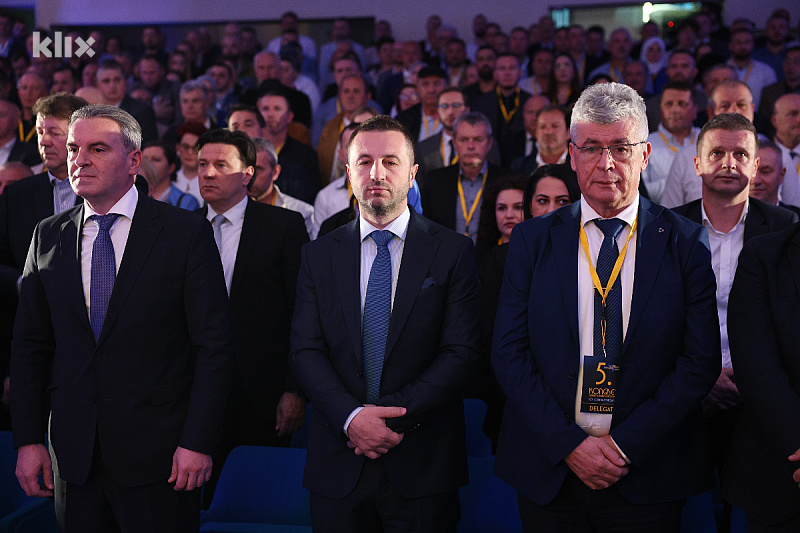
Semir Efendić was unanimously elected as the party president, being the only candidate. The congress was also attended by the founder and long-time party leader, Haris Silajdžić.
The Party for Bosnia and Herzegovina, as emphasized at the Congress, was founded in 1996 during a difficult period for our country, immediately after the end of the aggression against Bosnia and Herzegovina, when it was necessary to tackle the construction and strengthening of state institutions.
"For three decades, it has remained one of the key state-building and reform factors in Bosnia and Herzegovina. Throughout its work, it has been recognized for its consistent commitment to strengthening state institutions, preserving sovereignty and territorial integrity, as well as opposing ethnic divisions and solutions that weaken the state," stated the SBiH announcement.
In his address, Silajdžić reminded attendees of the key results achieved during periods when SBiH participated in government. He highlighted that numerous infrastructure and development projects were implemented across Bosnia and Herzegovina during that time, including industrial and energy projects, without legal or financial abuses.
"The Party for Bosnia and Herzegovina has left behind concrete results and projects implemented in the interest of the state and its citizens. That is a legacy we can be proud of," emphasized Silajdžić.
Speaking about political challenges, he also reflected on missed development opportunities, including energy projects that did not receive the necessary political support, noting that such investments would significantly contribute to economic development and strengthening the state.
"Today we have a candidate for the Presidency, Mr. Efendić, who proves through results that he knows how to work and is not corrupt. I am glad that this party has stayed on its path, showing that the state is more important than participation in government. For the first time in modern Bosnia and Herzegovina, a party did not enter government when it could have, but instead adhered to its principles," stated Silajdžić.
Professor Zlatko Hadžidedić also addressed the attendees, highlighting the historical and political role of SBiH, emphasizing that the party emerged as a response to the weaknesses of the Dayton constitutional framework, with the aim of protecting the functionality and long-term stability of the state.
"After entering government, SBiH has always been a corrective force, and from that position, it acted in one of the most significant events—stopping the April Package—which was a historic move and determined that today's Bosnia and Herzegovina still exists. Otherwise, the system of direct election for the Presidency of Bosnia and Herzegovina would have been abolished, with its members indirectly elected by parliamentary parties. Moreover, if the election of the Chairman of the Council of Ministers of Bosnia and Herzegovina did not occur by the third round, the Parliament would be dissolved. In an unstable state with its complex political relations, this would threaten a legal vacuum, making it impossible to elect an executive authority, and the state would cease to function, with statehood left to the entities," said Hadžidedić.
He emphasized that the Party for Bosnia and Herzegovina has been a corrective force in government and played a key role in the most important political processes, including preserving the institutional continuity of Bosnia and Herzegovina. He also spoke about contemporary political challenges, highlighting the need for caution in making strategic decisions that could have long-term consequences for the state system and resource management.
In the final part of the Congress, party president Semir Efendić addressed the attendees, emphasizing that Bosnia and Herzegovina is facing an election year that represents an opportunity for substantial changes.
"This is an election year—a year in which the citizens of Bosnia and Herzegovina have the opportunity to initiate changes. We face numerous problems: from the state of national cultural institutions and the public broadcasting system to challenges in industry, the energy sector, railway transport, as well as pronounced demographic issues. We do not seek solutions outside Bosnia and Herzegovina but rely on our own capacities, knowledge, and the potential of our people. Ignoring problems is not a solution—elections are the democratic and institutional path to change," stated Efendić.
He emphasized that the Party for Bosnia and Herzegovina will offer candidates for all levels of government in the upcoming election cycle, including the Presidency of Bosnia and Herzegovina, and stressed that the party remains consistent with the principles of independent political action.
He added that Bosnia and Herzegovina has the potential for progress in all areas, but responsible and competent personnel are needed to represent the state with dignity on the domestic and international stage.
Efendić expressed confidence that the Party for Bosnia and Herzegovina has a real chance of returning to all levels of government, recalling the period up to 2010, during which, as he noted, significant progress was made in strengthening state institutions and adopting legislative solutions.
"From 2010 to today, we have witnessed stagnation. The absence of the Party for Bosnia and Herzegovina in full government capacity is clearly felt, and I am convinced that we have the strength and support to change that," said Efendić.
He also emphasized that the party has demonstrated through its actions that its principles are more important than participation in government, recalling political decisions in which SBiH did not agree to solutions considered harmful to the state.
The Congress concluded that the Party for Bosnia and Herzegovina will continue to consistently implement its state-building policy, aiming to strengthen institutions, protect the constitutional order, and enhance the overall socio-economic development of Bosnia and Herzegovina.