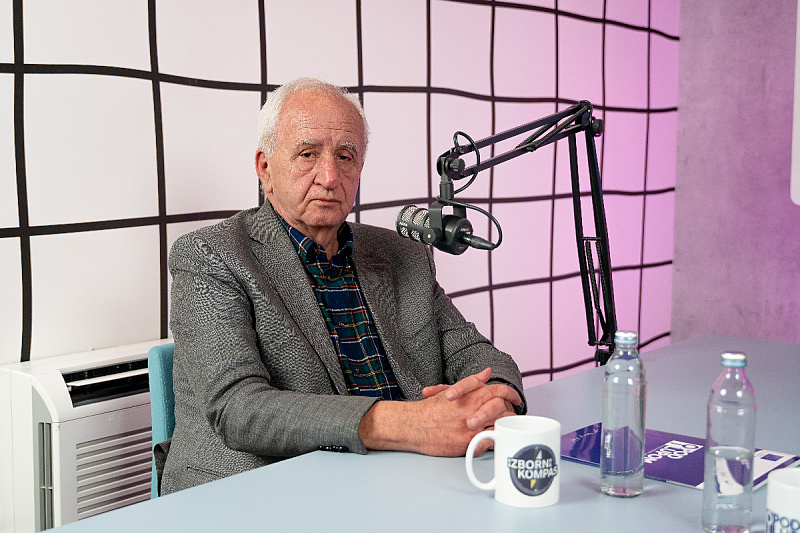
The guest of the episode is Vehid Šehić, president of the Strategic Committee of the "Under the Magnifying Glass" Coalition, former member and president of the Central Election Commission of Bosnia and Herzegovina (CIK BiH), and an expert in the field of elections, who in a conversation with Hasan Kamenjaković, through personal retrospection and decades of experience, analyzes the development of the electoral process, political blockades, and resistance to the introduction of new technologies.
Speaking about the beginnings of conducting elections in BiH, Šehić emphasizes that political irresponsibility and obstructions of electoral reforms are not from yesterday.
"That irresponsibility of the authorities, which we still have today, has been ongoing since 2001. And unfortunately, instead of breaking with that practice and obstructions, they continue their actions to this day, obstructing certain amendments to the BiH Election Law, specifically the introduction of new technologies that are very important," said Šehić.
The focus of the episode is the question of why electoral reform has been stalled for years and why key changes are not being implemented. Šehić believes it is wrong to talk about "political will," because the essential problem lies in the lack of responsibility.
"There is no political will. I am absolutely not interested in political will. There is no political responsibility. And that is the biggest obstacle to positive movements in building this state as a legal state. We live a life in which legal security is not guaranteed, where we have a division of citizens into those to whom the law does not apply and those to whom the law does apply," states Šehić.
According to his words, the long-term retention of the existing system is not accidental.
"They have turned a non-system into a system. We live in a state where politicians, but not all politicians, because we must not generalize, there are also those who sincerely want some changes to happen, formally want changes, but pray to God that they do not happen. Large parties, not all, but many, are satisfied with this system, without electronic voter identification and without scanners, because they have developed a strategy on how to obtain a larger number of votes in elections in an illegal way," states Šehić.
Long-term discussions with MPs, representatives, and delegates about the introduction of new technologies, Šehić describes as contradictory, although everyone is formally for changes, they are regularly blocked at sessions.
Šehić also emphasizes that current reforms and initiatives are largely driven by citizens and implemented by the OHR, although real responsibility and implementation should be in the hands of domestic institutions.
Šehić points out that politicians often criticize the OHR for decisions it makes regarding reforms and law enforcement. According to his words, such criticisms mostly serve to divert attention from their own (ir)responsibility.
"And what is absolutely unacceptable is that politicians very often attack the High Representative. And what is hypocritical, they attack him because he did the job they were supposed to do," says Šehić.
At the end of the episode, Šehić emphasizes that without more active engagement of citizens, there will be no substantial reforms.
"I again appeal to the citizens of BiH, voters in particular, to finally start voting for themselves and for their future. I hope that citizens will finally understand that they must fight for their own freedom because they will not be given it," concluded Šehić.