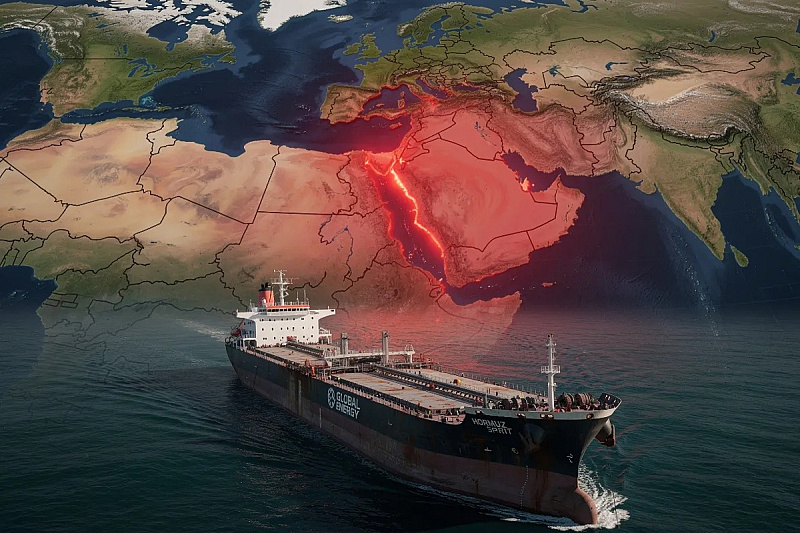
The blockade aims to further increase pressure on Iran's already weakened economy. However, officials note that Saudi Arabia has warned that Iran could retaliate by closing the Bab el-Mandeb Strait, a narrow passage in the Red Sea crucial for the kingdom's remaining oil exports.
Such a reaction highlights the risks and limitations of U.S. efforts to reopen the Strait of Hormuz, which Iran closed at the start of the war by attacking ships, halting about 13 million barrels of daily oil exports and driving prices above $100 per barrel.
The blockade of Iranian ports took effect on Monday, after Trump's threats of bombing and weekend negotiations failed to persuade Iran to relinquish control over the strait.
"President Trump has made it clear that he wants the Strait of Hormuz fully open to ensure the free flow of energy. The administration is in frequent contact with our Gulf allies, whom the president is helping to ensure that Iran cannot blackmail the United States or any other country," said White House spokeswoman Anna Kelly.
Saudi Arabia recently managed to restore oil exports to the pre-war level of about seven million barrels per day, despite the blockade of the strategic passage, by transporting oil via pipelines across the desert to the Red Sea. However, these supplies would be jeopardized if the exit from the Red Sea were also closed. Iran's Houthi allies in Yemen control a large portion of the coast near Bab el-Mandeb and have already severely disrupted navigation through this route for much of the Gaza war. According to Arab officials, Iran is pressuring this group to close the passage again.
"If Iran decides to close Bab el-Mandeb, the Houthis are an obvious partner for that, and their response to the Gaza conflict shows they have the capacity for such a move," said Adam Baron, a Yemen expert and fellow at the New America institute in Washington.
Iran's semi-official news agency Tasnim, close to the Revolutionary Guard that now controls the Strait of Hormuz, reported that the blockade could prompt Iran to also close the entrance to the Red Sea.
Gulf states do not want the war to end with Iran controlling the Strait of Hormuz, which represents their economic lifeline. Nevertheless, many, including Saudi Arabia, are pressuring the U.S. to resolve the issue through negotiations and are trying to restart dialogue, regional officials said. Despite publicly tough stances from both sides, the conflicting parties are actively communicating through mediators and are open to negotiations if they show sufficient flexibility.
The Bab el-Mandeb Strait is a narrow passage between Yemen and the Horn of Africa that connects the Red Sea to the Indian Ocean. Its name means "Gate of Tears," and it leads to the Suez Canal, representing one of the most important shipping routes between Asia and Europe. Houthi rebels, Iran's allies in Yemen, have demonstrated the ability to severely disrupt navigation by attacking ships. Although these attacks decreased after the Gaza ceasefire in October, traffic has not yet fully normalized.
The Houthis have largely stayed out of the current conflict between the U.S. and Iran, having suffered heavy blows during the 53-day U.S. campaign that ended with a ceasefire a year ago. However, they remain an important part of Iran's broader network of allies and a pressure tool that Iran can activate if it wants to increase pressure on the U.S.
The Houthis have signaled that closing Bab el-Mandeb is also one of the options they are considering.
Any attack on ships in this passage would be particularly concerning for Saudi Arabia, which redirected a large portion of its oil exports from the Ras Tanura facility in the Persian Gulf to the Yanbu port on the Red Sea, just days after the U.S. and Israel launched the war against Iran on February 28.
Before the Gaza war, about 9.3 million barrels of oil and petroleum products passed through Bab el-Mandeb daily. That traffic was halved after the Houthis began attacking ships in the area, according to data from the U.S. Energy Information Administration.
But Ali Akbar Velayati, foreign policy advisor to Iran's supreme leader, stated on social media on April 5 that Iran views Bab el-Mandeb "the same as Hormuz. If the White House thinks of repeating its foolish mistakes, it will quickly realize that the global flow of energy and trade can be disrupted with one signal."
Saudi energy officials told The Wall Street Journal that the kingdom has received assurances from the Houthis that they will not attack Saudi Arabia or its ships passing through Bab el-Mandeb. However, Riyadh has warned the U.S. that the situation is fluid and that the Houthis could become more aggressive in the conflict if Iran increases pressure, Arab officials said. They could also start charging ships for passage.
"That would be a way for Iran to retaliate with escalation, signaling that if you restrict our oil exports, we will disrupt your exports from the Yanbu terminal," said Erik Meyersson, chief strategist for emerging markets at Swedish bank SEB.
Last year, Trump sent two aircraft carriers, five B-2 bombers, a squadron of advanced F-35 fighters, and destroyers armed with guided missiles into the conflict with Yemeni militants.
During that conflict, the Houthis nearly shot down two F-16 aircraft and downed about six Reaper drones. A missile attack on the aircraft carrier USS Harry S. Truman forced the ship into a sudden maneuver, causing one F/A-18 aircraft to end up in the Red Sea.
On Monday, Iran also issued threats to neighboring ports.
"If the security of Iranian ports in the Persian Gulf and the Sea of Oman is threatened, no port in those areas will be safe," stated a release from the Iranian armed forces published by state television IRIB News.