Over three days, through lectures, workshops, and informal meetings, topics shaping the next phase of technology development were opened, with a special focus on artificial intelligence, software development, and the management of complex systems. An important part of the conference was the EXPO hall, which was exceptionally well-attended throughout all three days. It gathered partners and sponsors in one place and offered a cross-section of some of the most successful and relevant companies from Bosnia and Herzegovina and the region, creating space for direct conversations, new collaborations, and concrete business opportunities. Within the Summit, a closed-door Leadership Summit was also held, bringing together industry leaders in a format focused on strategic discussions about the development and management of AI systems. The event was organized by the same team behind the European Collaboration Summit, one of Europe's largest technology conferences, whose next edition is announced for May 2–5, 2026, in Cologne, Germany. Adis Jugo, one of the key people behind the conference, emphasized that the original idea was fully confirmed in Sarajevo: "We had a clear vision of what we wanted to achieve, and Sarajevo responded in the best possible way. People came for the content but left fascinated by the energy that happens when everything aligns perfectly. On the second night of the conference, we watched together the entry of the Bosnian national team into the World Cup and the spectacular, spontaneous celebration that took place on the streets of Sarajevo. I think that was the moment when our guests truly felt what it means to be here. Sarajevo and Bosnia and Herzegovina showed what makes them special—that combination of knowledge, openness, and spirit that cannot be planned but is certainly unforgettable." Participants showed particular interest in practical applications of artificial intelligence, especially the development and implementation of agent systems in real business environments. Instead of focusing on individual tools or functionalities, discussions shifted toward architecture, management, and the implementation of solutions in production. Lee Stott emphasized that the Sarajevo conference clearly demonstrated a shift in market expectations: "ATS clearly confirmed the move from AI solutions based on individual functionalities toward architecture, management, and real-world application. Developers and decision-makers today are seeking comprehensive, production-ready scenarios for agent systems, particularly in local and hybrid environments, which clearly shows where deeper exploration is needed in the coming period." Feedback from participants further confirms this picture. The need for concrete, applicable content—from initial experiments to implementation in real systems—was highlighted, with a focus on security, compliance, and oversight of AI solutions. Sessions connecting development teams, architects, and business decision-makers generated significant interest, further confirming that AI is no longer viewed in isolation but as an integral part of existing software and business processes. The organizer of ATS is an international team behind some of Europe's largest technology conferences. Elena Kovačević, Director of the Adriatics Tech Summit, noted that this year's first edition of ATS exceeded expectations. "Our advantage is that we are a well-coordinated, international team with serious experience in organizing large-scale conferences," said Kovačević. "Our goal was to raise the standard, for this region and far beyond, and we succeeded. Everything went smoothly, but more importantly, we delivered more than we promised, and the participants recognized that. This is just the beginning, and we are already preparing the next edition," she concluded. The Adriatics Tech Summit in Sarajevo confirmed that the region has the capacity to be a relevant meeting point for the global technology community, not only through content but also through experience and lasting value after the conference concludes.
Society
Sarajevo as a Tech Hub: Adriatics Tech Summit 2026 Gathers Leaders of the New AI Era
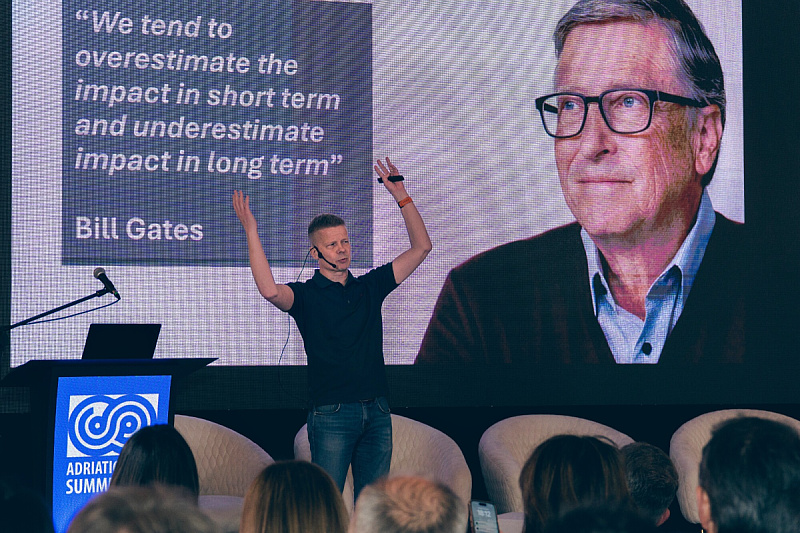
From March 30 to April 1, Sarajevo hosted the Adriatics Tech Summit 2026, an international conference that gathered over 500 participants, 60 expert speakers from a total of 21 countries worldwide, and 20 partners and sponsors.
ingestion