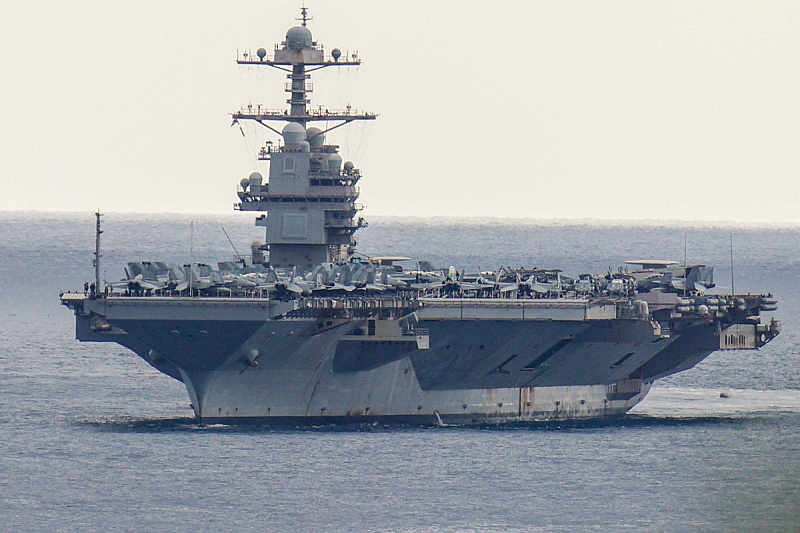
"More than 10,000 U.S. sailors, marines, and airmen, along with over a dozen warships and hundreds of aircraft, are conducting a mission to blockade ships entering and exiting Iranian ports," the statement said. As highlighted by CENTCOM, during the first 24 hours, no ship managed to break through the blockade, while six merchant vessels complied with the orders of U.S. forces and turned back toward Iranian ports in the Gulf of Oman. Recall that the U.S. blockade of maritime traffic toward Iranian ports began yesterday at 10 a.m. Eastern Time, or 4 p.m. local time, based on a decision by President Donald Trump. This move came after negotiations between the U.S. and Iranian delegations failed over the weekend in Islamabad. Following that, Trump announced a "double blockade" of the Strait of Hormuz, through which Iran had already restricted ship passage earlier. The U.S. military stated that restrictions will be enforced along the Persian Gulf, the Gulf of Oman, and the Arabian Sea, east of the Strait of Hormuz, and will cover the entire Iranian coast, including ports and energy infrastructure. CENTCOM warned that all ships attempting to enter or exit this area without authorization will be subject to interception, redirection, and seizure. However, it was emphasized that humanitarian shipments will be permitted. On the other hand, the Iranian Revolutionary Guard Corps (IRGC) announced retaliation, further increasing the risk of escalation in a region crucial for global energy supply.
Society
US: Hormuz blockade with 12 ships, 100 aircraft, and 10,000 personnel, no one has passed in 24 hours.
According to a statement from the U.S. Central Command (CENTCOM), more than 10,000 U.S. sailors, marines, and air force personnel are participating in the Hormuz Strait maritime blockade operation, supported by over ten warships and dozens of aircraft.
ingestion