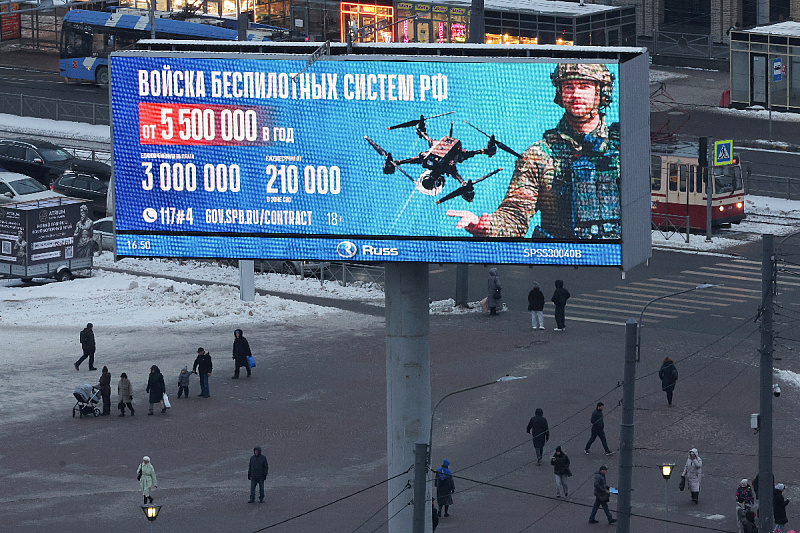
This recruitment campaign comes at a time when Russian forces continue to make slow progress on the battlefield in Ukraine, and while U.S.-mediated peace talks are on hold due to the war with Iran.
However, it is not part of a general mobilization, which the Kremlin said this week is not on the agenda. Also, according to senior officials, Russia is not short of recruits, despite Ukrainian claims—which Moscow dismisses—that Kyiv is eliminating Russian soldiers faster than they can be recruited.
Dmitry Medvedev, deputy chairman of the Security Council, told state media on Friday that Russia’s continuous recruitment system, which offers significant financial packages to volunteers, continues to yield results. Last year, more than 400,000 people applied, and this year so far more than 80,000, he said.
Nevertheless, Russia’s move to target students suggests that Moscow wants to direct more qualified personnel into its drone units, which, like Ukraine’s, are playing an increasingly important role in the war of attrition.
Drone operators on both sides typically operate at some distance from the front lines but are considered high-value targets that are actively sought out and eliminated if their positions are discovered.
The Far Eastern Federal University in Vladivostok promises students who sign up at least one year of extended academic leave, with the possibility of extension, and guaranteed tuition waiver upon return, as well as free accommodation and scholarships. It also commits to covering the costs of necessary military equipment and armaments.
Additionally, there is a significant financial package by local standards: a first-year salary of 5.5 million rubles ($125,000), a one-time payment of 2.5 million rubles ($57,000) after training, a monthly allowance of 240,000 rubles ($5,500), and an additional one-time payment of 200,000 rubles ($4,500) from the university.
"This is not only an opportunity to prove yourself, but also a unique platform for social and career advancement, with unprecedented support," states the university document published on March 19.
The Moscow State University of Civil Engineering offers similar large incentives, telling students they have the opportunity to become drone operators, engineers, or technical specialists.
The Russian State Hydrometeorological University in St. Petersburg also encourages students to apply. Their offer includes promises of earnings up to seven million rubles ($160,000) per year for drone operators.
The campaign targeting students, especially those in technical fields like engineering or aeronautics, coincides with a new advertising campaign on billboards, featuring a young drone operator with glowing eyes and high-tech glasses, with the slogan: "The new irreplaceable."
Meanwhile, Pavel Malkov, governor of the Ryazan region with over a million inhabitants, has ordered private and public companies to set quotas for recruiting workers who will sign contracts with the Ministry of Defense.
His order, published on the official government website and reported by state media, stipulates that companies with up to 300 employees must provide two recruits, those with up to 500 employees three, and companies with more than 500 workers five recruits.
The decree does not specify what penalties might follow for companies that fail to meet the quotas, which are valid from April to September, but emphasizes that Malkov will personally oversee their implementation.