"I'll say one more thing - how fast it goes by. I'm not ready to go home," said Koch. She also spoke enthusiastically about how well the Orion spacecraft performed when she had the chance to manually pilot the vehicle, noting it was one of the most surprising aspects of the mission so far. "How precise the control algorithms were and how they responded when we actually intentionally degraded them," she noted, referring to a test flight in which the Orion spacecraft deliberately shut down some of its thrusters so the crew could assess how it would fly in a scenario where some engines stopped working. "It was just incredible to be in a deep-space spacecraft and just manually pilot it," she said. In a rare opportunity not seen since the Apollo era, the Artemis II mission astronauts spent the last hour enjoying a total solar eclipse from their perspective in the Orion spacecraft. They were able to photograph and observe the Sun's outer atmosphere and see stars, planets like Venus, Mars, and Saturn, and the glow of Earth. The crew reestablished contact with mission control after an expected 40-minute communication blackout as the spacecraft ventured behind the Moon and is now on its way back to Earth.
Society
The first woman to fly around the Moon: It was incredible, I'm not ready to go home yet
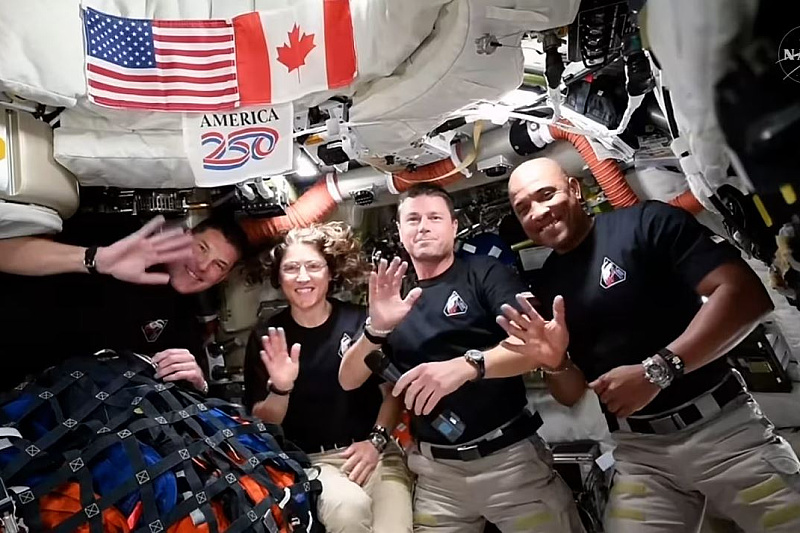
Astronaut Christina Koch, who today became the first woman in history to complete a lunar flyby, told NASA chief Jared Isaacman that she is adapting quite well to life in space.
ingestion