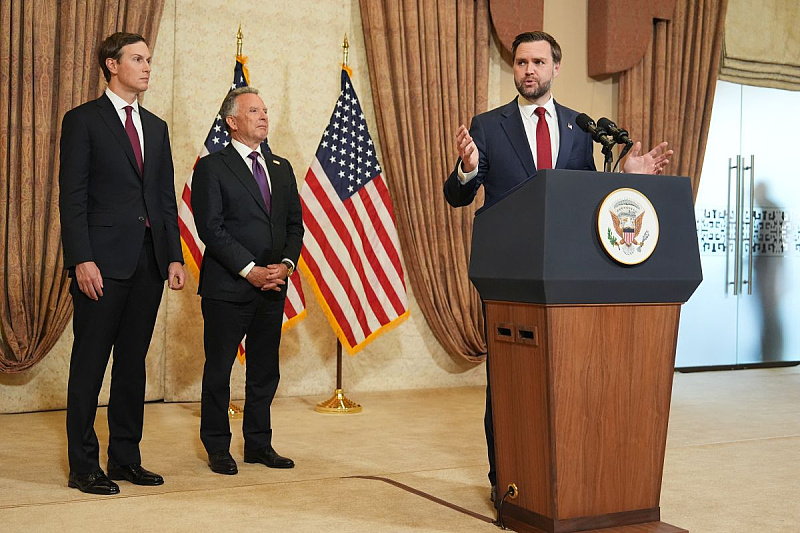
U.S. Vice President JD Vance left Pakistan after talks failed, and he spoke about the details at a press conference.
The negotiations, which began on Saturday local time in Islamabad and lasted overnight until Sunday morning, did not result in an agreement on a permanent end to the war. The talks lasted a total of 21 hours.
"I think that's bad news for Iran much more than it is bad news for the United States. So we're returning to the United States without having reached an agreement," Vance said.
He stated that the U.S. had made its final and best offer.
Vance said Iranian negotiators refused to accept the American terms for an agreement, which he insisted were "quite flexible."
"We were quite accommodating. The president told us: 'You need to go there in good faith and put in your best effort to reach an agreement.' That's what we did, and unfortunately, we failed to make any progress," he said.
Regarding Tehran's nuclear program, he said Iran had not committed to abandoning the development of nuclear weapons after hours of negotiations.
"The question is: 'Do we see a substantial commitment from the Iranians not to develop nuclear weapons, not just now, not just for two years, but in the long term?' We haven't seen that yet, but we hope we will," Vance said.
Vance said he had been in "consistent" communication with President Donald Trump during the negotiations. He also said he had spoken with other top officials, including Secretary of State Marc Rubio, Secretary of Defense Pete Hegseth, Treasury Secretary Scott Bessent, and Admiral Brad Cooper, commander of U.S. Central Command.
Meanwhile, Iranian state media blamed the failure of the talks on "excessive" U.S. demands.
"Negotiations between the Iranian and American teams ended a few minutes ago, and due to what is described as U.S. overreach and ambition, the two sides have so far failed to reach an agreement," reported a correspondent from the semi-official Tasnim news agency in Islamabad.