For Saab enthusiasts across Europe, the name Zanetti Omero S.n.c. carries special weight. This family business, founded in 1982 and linked to the then Italian importer SIDAUTO, built a reputation as a fully authorized sales and service center during the years when Saab had a strong presence in the Italian market. What sets Zanetti Omero apart from most former Saab dealers is its uninterrupted continuity, even after 2011. While many across Europe abandoned the brand or shut down their Saab operations, this service center retained the technical knowledge, tools, and capabilities needed to maintain these vehicles, remaining one of the few active Saab centers in Italy. That is why their latest discovery is not a promotional story or a bid for "clicks," but an authentic field find, documented by people who still work with Saab vehicles daily. It all started with a tip from the SaabWay Club Italy network, which continues to track and uncover hidden cars beyond the "visible" market. Based on this information, Zanetti Omero located a locked garage and gained access to a space that, according to available evidence, can be described as a true anomaly.
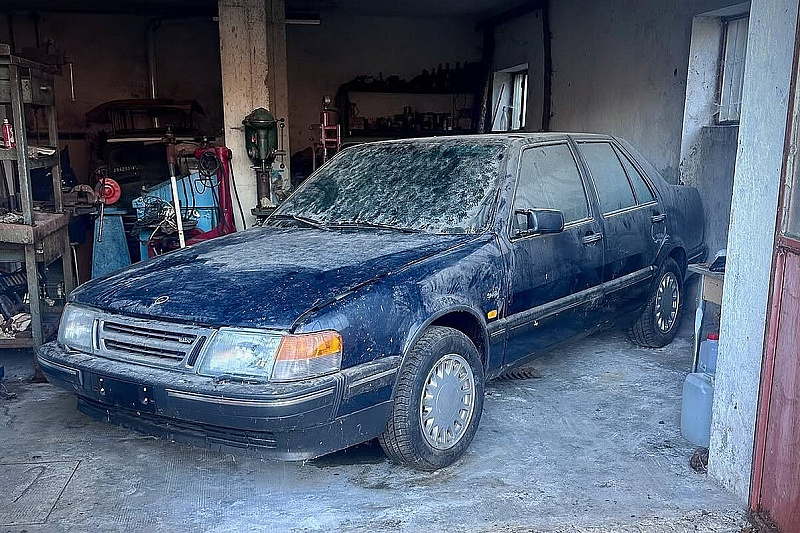
Two gems in the garage Inside the garage were two Saab 9000 Turbo models that had never been registered or legally driven on the road. According to Zanetti, the vehicles had been locked away since the late 1980s, essentially frozen in time for over three decades. They were neither restored nor intentionally preserved—they were simply left behind. It is this fact that gives the discovery its special technical and historical significance. The identity of the vehicles further confirms their authenticity. They are a white 1987 Saab 9000 Turbo with just 242 kilometers and a blue 1988 Saab 9000 CD Turbo with only 61 kilometers on the clock. The instrument readings, interior condition, and original materials clearly indicate that the cars have remained practically untouched, while the engine compartments appear complete and show no signs of intervention. Particularly significant is the claim that the engines are not seized and the electrical systems show signs of functionality. This means that, despite decades of inactivity, these cars are not reduced to static exhibits but remain mechanically viable units. In this sense, they are not low-mileage vehicles but cars that never even began their life on the road. The environment in which they were found further clarifies their condition, though not their story. The garage does not look like a controlled storage space but rather an abandoned workshop where tools were left in place, with no preservation measures taken. A layer of dust and traces of long-term inactivity confirm that the space had been untouched for decades.
Models from the early production phase Such a scenario is not unknown in Europe, where many small workshops or private owners simply ceased operations, leaving vehicles behind without formal closure. However, what sets this case apart is the exceptional condition of the cars themselves. A key question remains unanswered: why were these two Saab 9000 Turbos never registered or delivered, even though they were fully functional? It is this mystery that further amplifies the significance of the entire discovery. The discovered examples belong to the early production phase of the Saab 9000 model, before later modifications that affected materials and technical details. As a result, they now represent rare, almost reference specimens for understanding the original design and characteristics of this model.