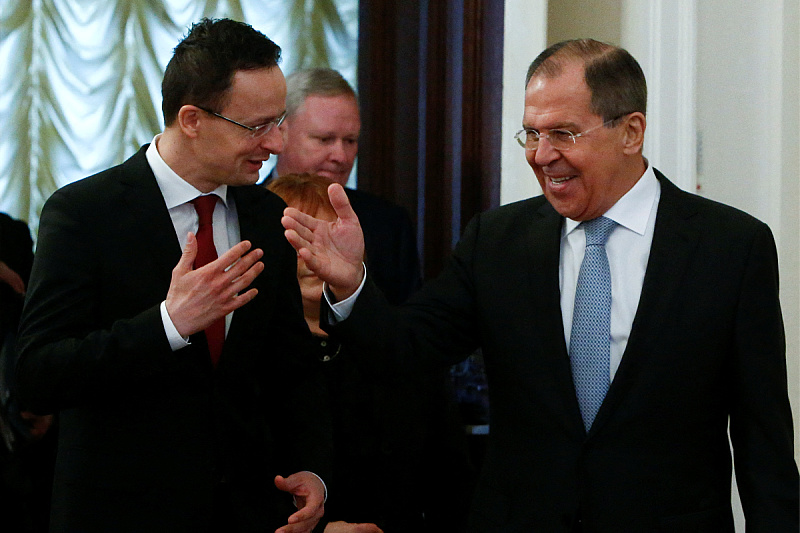
The Hungarian government has signed an agreement with Russia to expand economic, trade, energy, and cultural ties between the two countries, according to documents prepared by the Russian government and obtained by Politico. They clearly emphasize how close relations Budapest and Moscow aim to establish.
Hungarian Foreign Minister Peter Szijjarto and Russian Health Minister Mikhail Murashko signed a 12-point plan defining areas of cooperation after a meeting in the Russian capital in December, the documents show. The text, which had not been previously published, reveals the extent to which the two governments would align in areas such as nuclear fuel, education, and sports.
The December summit in Moscow was the 16th meeting of the Russian-Hungarian Intergovernmental Commission on Economic Cooperation (IGC), which was launched in 2005 according to Russian state media. The commission has since met approximately once a year, in Russia or Hungary, with a pause between the 14th meeting in November 2021 and the 15th in September 2024. Russia launched its full-scale invasion of Ukraine on February 24, 2022.
According to one of the documents, Russia and Hungary discussed current issues of bilateral trade and economic cooperation, joint activities in the energy sector, industry, healthcare, agriculture, construction, and other areas of mutual interest, as well as in cultural and humanitarian spheres at the meeting in Moscow on December 9, 2025.
They also emphasized the importance of developing long-term, mutually beneficial relations between the two countries in areas of common interest.
Among the agreed points is a commitment to reverse the negative trend in bilateral trade, after the exchange of goods declined due to European Union sanctions imposed on Russia in response to the war in Ukraine.
The agreement also opens the door for Russian companies to launch new projects in the electricity and hydrogen sectors in Hungary, as well as for closer cooperation in oil, gas, and nuclear fuel.
Budapest has agreed to explore strengthening Russian language teaching in the country by importing teachers from Russia, as well as enhancing mutual recognition of qualifications and opening exchange programs for postgraduate students, according to the text of the agreement.
Under the terms of the agreement, the Hungarian government supported the continuation of exchange programs in areas from sports to circus arts, although Moscow is regularly accused of using cultural events to spread its narratives about the war in Ukraine and to legitimize the regime in Moscow. The two sides supported the idea of an action plan for joint cooperation in sports for the period 2026–2027.
Closer ties with Russia must not conflict with Hungary's obligations arising from its membership in the European Union, one of the documents states.
The Hungarian prime minister opposes EU efforts to tighten sanctions on Russia and provide material support to Ukraine.
On Tuesday, Bloomberg reported that Viktor Orbán told Russian leader Vladimir Putin in an October 2025 phone call that he would help "in any way he can" and that Hungary would be a "mouse" in relation to Moscow's "lion."
Orbán faces the toughest test of his 16-year rule in Sunday's parliamentary elections, where his populist Fidesz party trails the centrist opposition Tisza in the polls.
He has tried to present his friendly relations with Moscow as an advantage in the campaign, accusing his main rival Magyar of planning to drag Hungary into the war in Ukraine and jeopardize its access to Russian fossil fuels.
The Hungarian election campaign has been marked by a series of strategic leaks, cyber surveillance, espionage allegations, and mutual accusations among diplomats, with voting starting on Sunday.