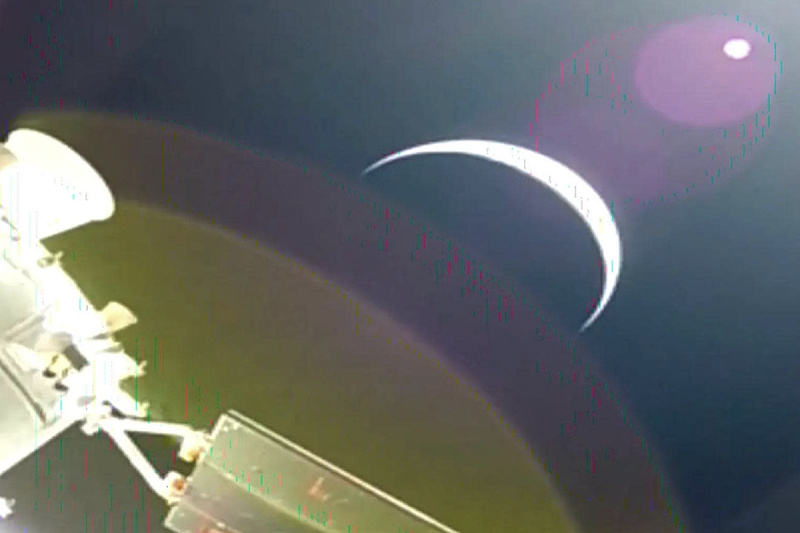
NASA, the U.S. space agency, announced that it has successfully completed a critical firing of the Orion spacecraft's main engine. This six-minute engine burn provided approximately 2,700 kilograms of thrust, giving the spacecraft the acceleration needed to set it on course toward the Moon.
"Today, for the first time since Apollo 17 in 1972, humans have left Earth's orbit. Orion is also carrying a crew in space for the first time, and we are gathering crucial data and learning from every step," said Dr. Lori Glaze from NASA headquarters in Washington.
After leaving Earth's orbit, mission commander Reid Wiseman described the view as "a spectacular moment of the entire world from pole to pole."
The Artemis II mission was launched on April 2 after midnight local time, following several delays caused by a hydrogen leak and later a helium issue. This is the first crewed flight under the Artemis program and the first time humanity has ventured beyond low Earth orbit since the Apollo program ended. Within hours of launch, astronauts reported a problem with the vehicle's toilet, which crew member Christina Koch eventually resolved. Commander Wiseman then reported to mission control that they were having issues with Microsoft Outlook on the Surface Pro device they were using, but these ultimately proved to be manageable problems that did not prevent the crew from achieving the mission's objectives.
The mission is taking NASA astronauts Reid Wiseman, Victor Glover, and Christina Koch, along with Canadian Space Agency astronaut Jeremy Hansen, on a ten-day journey around the Moon. On April 6, the spacecraft will pass by the far side of the Moon, which humans have never directly seen before, and the crew will take photographs and provide their own observations of the lunar surface.