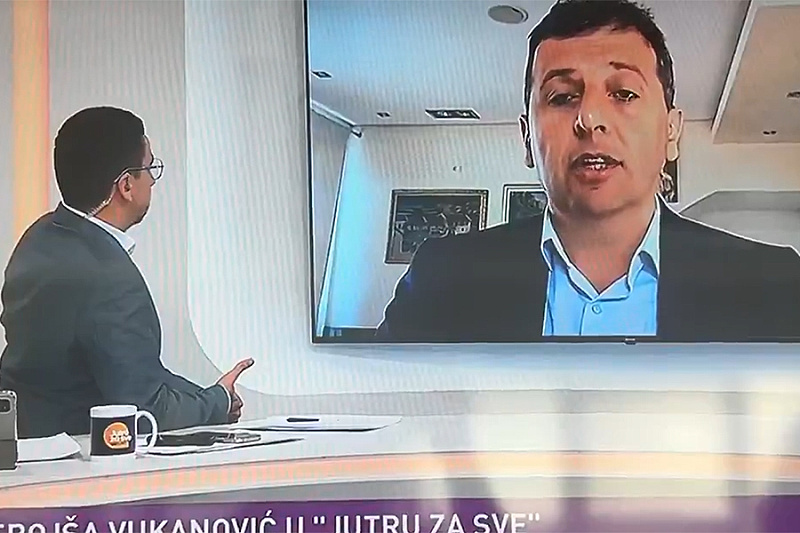
The interruption of an interview on BHRT's Morning Program, when journalist Zvonko Komšić ended the conversation after a somewhat heated exchange with his guest, politician Nebojša Vukanović, became the topic of the day. The essence of the conversation culminated with the journalist's question: Will you cheer for Bosnia and Herzegovina at the World Cup? The guest replied that he is happy about BiH's successes, but that one cannot love two women, alluding that his primary choice is the country he cheers for—Serbia.
This is a particular topic that lays bare all our paradoxes. If we imagine that somewhere else in the world an interview was interrupted over the question of who someone cheers for, it would be hard to believe. But sports in BiH, and often in the region, is not just sports—it is also politics.
The success of the BiH football team qualifying for the World Cup is not only a great sporting achievement; it was a dire need for this country, providing energy and hope that BiH can succeed, and perhaps that sports are the only hope and the only field where a cohesive element can be sought in a fragmented political society.
But isn't it somewhat unfair to sports and athletes to place the burden of all a country's political and social problems on sports? Yes, sports can help bring people together, but they cannot solve decades-long national and social issues.
In a political sense, after the great sporting success of BiH's football players, emotions carried all layers of society. Then, somewhat naively, it is expected that this wonderful sporting moment will heal all our divisions and political problems. Hence, perhaps, the question to a politician about who they will cheer for. And a politician being a politician, half of the answer might be honest, driven by emotion, while the other half will be calculated precisely because of politics.
Now, because of Vukanović's answer that he cheers for Serbia, his entire political profile is being assessed. Has he been falsely presenting himself for years as a correct politician and an alternative to Milorad Dodik from Republika Srpska, or is he perhaps a hidden Chetnik or something else? Everything can be questioned, but the answer should not be sought through the question of who someone cheers for.
After all, there are many political situations and national topics on which the same Vukanović could have sought political points by presenting himself as a great Serb, but he did not do so. The reactions that followed only show how sensitive, impatient, and emotion-driven society is.
Attacks on journalist Zvonko Komšić, on the other hand, parallelly show how such a situation is wanted to be exploited for another kind of demonization. Thus, politician Vukanović sought sanctions from BHRT against journalist Komšić.
After all, who any politician cheers for is not important and should not be primarily important to Bosniaks, Serbs, or Croats. What is important is what those same politicians do to solve real problems.
Sports are merely incidental folklore—an important cohesive fabric, but still incidental folklore. And yes, 99 percent of politicians from Republika Srpska will say they primarily cheer for Serbia. The situation that captured public attention ultimately does not mean that Vukanović is a wolf in sheep's clothing, a nationalist, or a Chetnik. He is more of an imprudent politician. Nor is Komšić unprofessional, but someone who does his job sincerely and with emotion.
And those who expect state loyalty to be given through cheering or sports parallels should broaden their demands and view the state a bit more seriously.