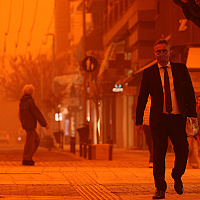
The sky over Crete on Wednesday (April 1st) took on dramatic hues after the island was engulfed by a dust cloud from the African continent. The city of Heraklion was literally plunged into an orange color, created when strong winds lift sand and dust particles from the Sahara Desert and carry them across the Mediterranean Sea.
This unusual phenomenon arrived carried by a cyclone moving from North Africa. Alongside vast amounts of dust, the storm front brought strong winds and rain to this Greek island.
According to local media and Reuters, the extremely poor visibility caused by the dust forced authorities to urgently divert flights destined for Crete to other airports.
The arrival of Saharan sand in Southern Europe is a relatively frequent occurrence, especially during the first half of spring. It is caused by sandstorms in North Africa, where strong winds lift fine dust high into the atmosphere, after which warm southern currents carry it toward Europe.
When the floating dust covers the sky, it causes reduced visibility and haze, but also spectacular sunrises and sunsets in intense red and orange tones. On the other hand, when the dust settles into the lower layers of the atmosphere, it can significantly worsen air quality and pose a health risk to sensitive groups of citizens.
The phenomenon of so-called "blood rain" also often occurs, precipitation that leaves behind a recognizable sandy and muddy film on cars and windows.
Under favorable weather conditions, Saharan sand frequently reaches our regions, and even Central Europe, where high concentrations of dust can cover and color the snowy peaks of the Alps and the Pyrenees.