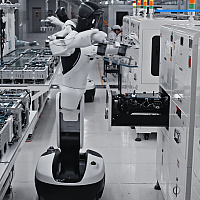
The deployment of the Agibot G2 robot at the Shanghai-based electronics manufacturer Longcheer Technology marks a step toward real-world industrial application of embodied AI systems. Agibot G2 units are now operating on multimedia-integrated testing stations, performing precise loading and unloading tasks. According to Agibot, the deployment highlights the growing role of humanoid robots in manufacturing environments, demonstrating their ability to handle repetitive and high-precision operations within existing production workflows. In March, Agibot announced the deployment of its 10,000th humanoid robot, signifying a key milestone in the industrialization of embodied artificial intelligence. At Longcheer Technology’s production facilities, Agibot G2 robots are currently deployed at its multimedia-integrated testing stations. The robots are responsible for executing precise loading and unloading tasks. These operations require a high degree of accuracy, consistency, and coordination, showcasing the maturity of Agibot’s hardware and software systems in handling repetitive industrial processes. The testing stations combine multiple functional modules, demanding seamless interaction between perception, motion planning, and manipulation. According to Agibot, the G2 robots utilize multimodal sensor capabilities, including visual perception and spatial awareness, to accurately identify objects and execute task sequences. Their ability to operate continuously within structured production workflows underscores their readiness for industrial application. According to Agibot, the deployment is part of a broader strategy to build a full-stack ecosystem for embodied intelligence. The company integrates robot hardware, AI models, and large-scale data infrastructure to enable continuous learning and improvement. Through this approach, robots are not limited to predefined instructions but can adapt to variations in tasks and environments over time. "This project demonstrates that embodied AI is no longer experimental. It is a practical, production-ready capability that can reliably operate in real industrial environments and deliver measurable economic value," said Maoqing Yao, Partner, Senior Vice President, and Head of the Embodied Business Division at Agibot. The system is capable of handling high-precision manufacturing tasks, navigating complex factory layouts, placing devices into test carriers with millimeter accuracy, and sorting finished or defective units accordingly. Unlike conventional industrial automation, the system does not require custom tooling and supports mixed-model production, enabling faster changeovers and significantly reducing downtime. Agibot claims the deployment has demonstrated strong, quantifiable performance in key industrial metrics, including throughput of up to 310 units per hour, a cycle time of approximately 19 to 20 seconds per operation, and a success rate exceeding 99 percent in continuous operation. Production line integration was completed within 36 hours, with output reaching approximately 3,000 units per shift. The system supports 24/7 autonomous operation with minimal human intervention, achieving over 140 hours of cumulative continuous operation while maintaining downtime loss below 4 percent. A single Agibot G2 robot can replace multiple manual processes while maintaining consistent production, enabling manufacturers to balance efficiency, cost, and flexibility within a unified system. The system’s performance is driven by Agibot’s embodied AI approach, enabling rapid robot deployment, adaptation to changing production conditions, and reliable operation in fast-paced manufacturing environments. By combining simulation-based validation, reinforcement learning, and on-device intelligence, the system minimizes setup time, reduces the need for manual tuning, and ensures stable performance in continuous production. With multiple units already in operation, Agibot plans to expand deployment to 100 robots by the third quarter of 2026, accelerating adoption across industries including automotive, semiconductors, and energy. Experts believe this development reflects a broader shift in manufacturing from rigid, hardware-defined automation toward flexible, software-driven intelligent systems powered by embodied artificial intelligence.