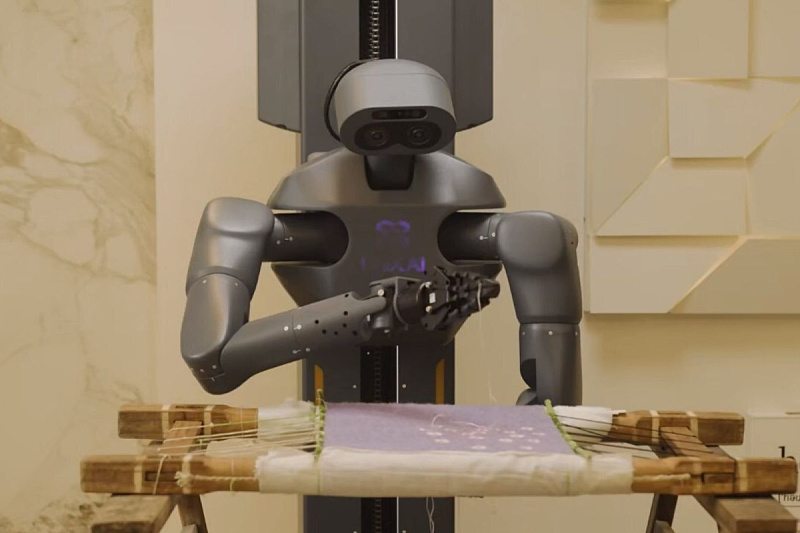
UniX AI has commenced global deliveries of its third-generation Panther humanoid robot, featuring wheels and two arms. Standing approximately 170 cm tall and weighing around 80 kilograms, it operates for eight to 16 hours on a single charge.
According to the Suzhou-based company, its design focuses on usability and reliable performance in complex indoor environments, marking a significant step toward integrating general-purpose humanoid robots into everyday settings.
Panther is a wheeled, dual-armed humanoid robot designed for real-world applications in domestic, commercial, and industrial environments. Equipped with an omnidirectional chassis that moves, steers, and drives on all four wheels (4WS+4WD), it enables agile movement and stable operation in complex indoor settings. UniX AI notes that the wheeled architecture represents a departure from the more common legged humanoid approach, combined with general-purpose AI models, offering enhanced efficiency and practicality for deployment.
Per UniX AI, the robot features 34 high-degree-of-freedom joints, including the world's first mass-produced bionic arms with 8 degrees of freedom of motion and adaptive intelligent grippers, enabling precise and flexible manipulation.
Additionally, it is outfitted with cameras, sensors, and audio systems that support object recognition, indoor navigation, and human interaction. The system is designed to handle multi-step tasks rather than isolated actions, allowing it to execute complete activity sequences.
"With our integrated trinity of algorithms, hardware, and applications, we have already progressed from laboratory validation to mass delivery, and from local deployment to global expansion," said Fred Yang, founder and CEO of UniX AI.
In demonstrations and early applications, the robot has shown the ability to perform various household tasks. These include waking users, preparing breakfast, cleaning rooms, organizing household items, and managing certain devices. It can also sort and relocate objects as part of routine household workflows.
The robot is built to efficiently manage continuous task sequences. For example, it can wake a user in the morning, prepare a meal, clean the kitchen afterward, and organize living spaces, demonstrating coordinated, multi-step task execution in real home environments.
Panther evolved from the Wanda 2.0 platform and introduces an 80 cm vertical upper-body lift, enabling both elevated reach and ground-level work. It runs on an upgraded 48 V power platform, delivering greater power with improved stability for rapid control and dynamic movements.
Panther is powered by UniX AI's integrated technology suite. UniFlex enables efficient task generalization across different scenarios and imitation learning. UniTouch combines visual-tactile multimodal models to enhance precise handling and interactive capabilities with improved stability. UniCortex supports long-term task planning, allowing the robot to seamlessly execute complex, multi-step operations.
According to the company, the system is designed for a wide range of real-world applications. These include commercial services such as hotels, receptions, retail, and guided tours, as well as home and personal use like household chores, elderly care, and companionship, plus public or industrial roles, including security patrols, research, and education.
Experts note that home robots still face challenges, including cluttered environments, varying lighting, and handling soft objects. Issues in navigation, device interaction, battery life, cost, safety, and reliability persist. However, robots performing multiple household tasks indicate that fully functional home assistants handling daily chores are gradually becoming a reality.