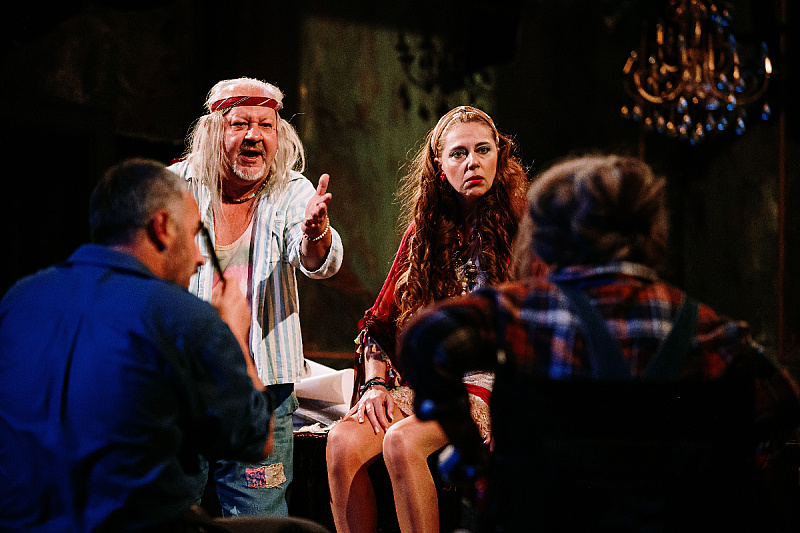
The performance will be presented as part of the "Theater for All" initiative on Saturday, April 11th at 7:30 PM, with free admission.
"Tango" is a drama of the absurd that uses a satirical and witty tone to portray a deeply serious theme—the collapse of family and societal values. The plot is set in a chaotic household where no rules apply anymore: the parents vividly revel in the anarchy they have created, while their son, the young intellectual Arthur, desperately struggles to establish order, structure, and meaning.
In a world where everything is permitted, Arthur seeks to establish authority, morality, and tradition—what most young people have rejected in the rebellious fervor of previous generations. However, his attempts are met with misunderstanding, ridicule, and passive resistance. As tension mounts, Arthur sinks deeper into inner conflict, unable to find an answer to the question: how can order be established in a society that no longer recognizes boundaries?
The performance brings together the outstanding acting ensemble of the National Theater Tuzla, whose powerful interpretations of the characters showcase the richness of Mrożek's dramaturgy and the depth of his philosophical reflection.
"Tango," produced by the National Theater Tuzla, features: Adnan Omerović, Elvira Aljukić, Nermin Omić, Remira Osmanović, Milenko Iliktarević, Jana Miletić, and Elvis Jahić. Through this play, Mrożek raises key questions of the modern age—what happens when freedom loses its meaning? Who governs society when authorities fall and normative systems cease to exist? Through dynamic and witty dialogues, "Tango" reveals the tragic helplessness of the individual to change a world that has voluntarily collapsed into chaos.
Radoslav Milenković, one of the most prominent theater directors and actors in the region, brings a unique reading of this classic text, focusing on universal themes that transcend time and space—the need for identity, resistance to authority, and the limits of freedom. His direction is characterized by precision, layered psychological analysis, and a subtle balance between comedy and tragedy. In this play, he opens a space for reflection on contemporary social movements and the loss of identity in an era of relativization of all values.
Through the cultural initiative "Theater for All," the National Theater opens its doors to the widest audience, nurturing the idea that art should be accessible to everyone. As part of this initiative, a performance intended for the public is staged once a month with free admission, thereby breaking down barriers between the stage and the audience. This initiative is an invitation to a shared experience, encounter, and dialogue, reminding us that theater lives precisely through the people for whom it is intended.