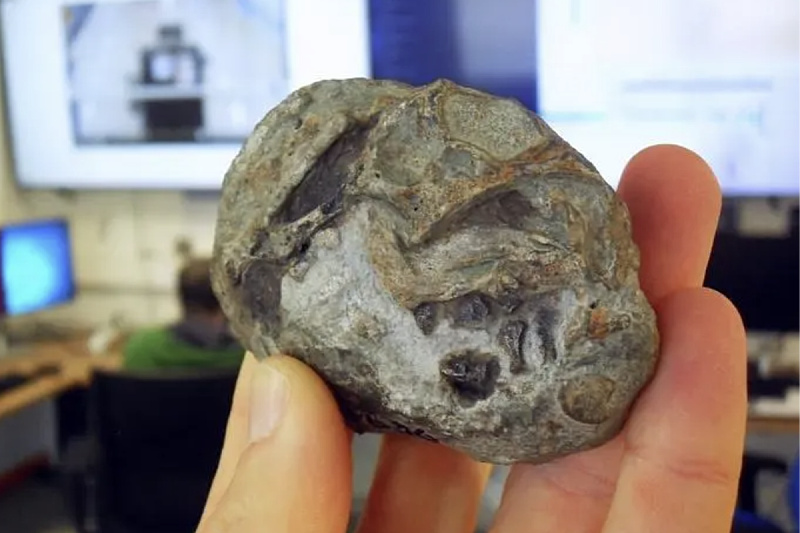
The embryo belonged to Lystrosaurus, a robust herbivore that survived the mass extinction at the end of the Permian period about 252 million years ago. This discovery provides the first direct fossil evidence that early ancestors of mammals laid eggs.
The mass extinction at the end of the Permian, known as the "Great Dying," wiped out 90 percent of all species. At that time, the planet was largely a dust-choked wasteland, scorched by extreme heat and relentless drought. Yet, among the ruins, these creatures with barrel chests and tusks managed to survive and even thrive.
"This research is important because it provides the first direct evidence that mammalian ancestors like Lystrosaurus laid eggs, thereby resolving a long-standing question about the origin of mammalian reproduction," said Julien Benoit from the University of the Witwatersrand in Johannesburg, who led the study.
In 2008, a fossil hunter named John Nyaphuli found a small stone nodule in South Africa. Inside was a tiny, curled-up skeleton.
Professor Jennifer Botha from the University of the Witwatersrand in South Africa suspected for 17 years that it was a juvenile that died before birth. However, the evidence was invisible to the naked eye.
An international team turned to the European Synchrotron Radiation Facility (ESRF) to carefully examine the hidden contents of the egg.
"Understanding reproduction in mammalian ancestors has been a long-standing enigma, and this fossil provides a crucial piece of this puzzle. It was essential to scan the fossil to capture the level of detail needed to resolve such tiny, delicate bones," said Dr. Vincent Fernandez, a scientist at ESRF in France.
The key evidence for the embryo's identity lies in its incomplete mandibular symphysis, meaning its unfused lower jaw. Since the two halves of the mandible had not yet joined, the creature would have been physically incapable of feeding independently. This structural incompleteness proves that Lystrosaurus was still in a developmental stage before hatching.
The embryo, nestled inside the egg, finally settled the long-debated question of whether mammalian ancestors laid eggs.
Unlike the hard, brittle eggs of tyrannosaurs, Lystrosaurus carried soft-shelled eggs. These eggs are rare in the fossil record because they decay easily.
Lystrosaurus had no time for slow growth. It lived in a world of rapid climate change. The research reveals a "live fast, die young" strategy.
The creature likely employed a "big egg" strategy to survive in a hostile post-extinction world. It produced yolk-rich eggs, and the embryos could develop into precocial hatchlings—young born at an advanced stage and capable of independent survival without parental milk or feeding.
These larger, soft-shelled eggs were also more resistant to desiccation in drought-prone environments. This allowed the species to survive the vulnerable early life stage and reach reproductive maturity faster.
Ultimately, this reproductive strategy explains how Lystrosaurus dominated the barren landscapes after Earth's most severe mass extinction.
Understanding how a species adapted to extreme environmental stress could help researchers better predict how modern animals might respond to climate change and habitat disruptions.