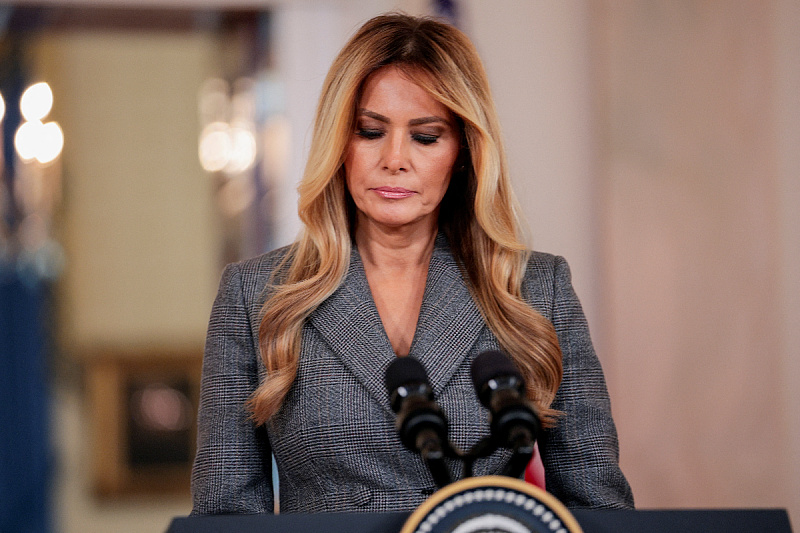
Her stunning statement to cameras in the Cross Hall of the White House, where her husband addressed the nation last week about the war with Iran, will almost certainly have the opposite effect. "I am not an Epstein victim. Epstein did not introduce me to Donald Trump," she said, in a statement made all the more striking because there have been no widespread public speculations on the topic in recent days. Trump said she was never friends with Epstein, but that she and her partner Donald Trump occasionally encountered him in social circles in New York and Florida. "The lies linking me to the disgraced Jeffrey Epstein must stop today," the first lady said, though she did not specify any particular accusations. The impression was of someone fed up with reports and speculations she believes falsely connect her to Epstein. But she was not speaking in a vacuum. Her personal position is further complicated by her proximity to her husband, who leads an administration that Epstein's victims accuse of silencing them, CNN writes in its analysis. The first lady's speech, lasting just under six minutes, was focused solely on the Epstein affair. Yet its implications reach far beyond, as she chose a moment of great political vulnerability for her husband to speak out publicly. Melania Trump spoke from a White House that appears to be losing control of the narrative around Donald Trump's second term. This trend is reflected in his impulsive and concerning outbursts and threats regarding the war with Iran, which have drawn sharp criticism even among otherwise loyal conservative media figures. Given that war dominates conversations in Washington, the question arises: why did the first lady, who values privacy and is known for a certain independence from her husband, decide now to issue a statement that was clearly going to stir controversy. Part of the motivation was clearly personal. Melania Trump lashed out at what she called baseless and unfounded lies about her connections to the financier who took his own life in a Manhattan jail cell in 2019. She mentioned a friendly email exchange in 2002 with Epstein's now-imprisoned associate Ghislaine Maxwell. She signed her message "Melania with love," to which Maxwell replied calling her "sweetie." On Thursday, the first lady said her response was merely casual correspondence and a trivial message. Donald Trump has also denied any connection to Epstein's illegal activities and claims he cut ties with him in the early 2000s, before his criminal acts came to light. There is no evidence of illegal activities by either Trump spouse. Nevertheless, Trump, like many other influential men, is under pressure to explain what he knew about Epstein, who had an exceptionally wide network of power and influence. His wife had not publicly spoken about this affair until Thursday. However, she previously extracted apologies from publisher HarperCollins, Democratic strategist James Carville, and the Daily Beast for attempts to link her to Epstein. One unresolved question is the extent of the West Wing's political involvement in her address. A person familiar with the situation told CNN that the president knew his wife planned to speak. Yet shortly afterward, the president told MSNOW he knew nothing about it. This impression of contradictions and lack of direction in the White House is also seen in shifting explanations and disagreements regarding the war with Iran. Trump has for months claimed the Epstein affair is a "Democrat-led hoax" and signaled it's time for the country to move on. His frustration that the scandal continues to unfold was reportedly one reason he dismissed state prosecutor Pam Bondi last week. Almost every time the White House has tried to calm this affair, the situation has worsened. At key moments, Epstein's victims speaking publicly about their experiences have given new momentum to the issue. The U.S. first lady's statement could have a similar effect. By publicly airing her frustrations, she risked undermining the White House's message that there is no reason for interest or concern regarding Epstein. She also spoke in the context of warnings from surviving victims that justice is being denied by a hostile administration. Her statement could also be interpreted as an argument that these victims deserve a chance to speak publicly and be heard. "Every woman should have the opportunity to tell her story publicly if she wishes, and then her testimony should be permanently entered into the Congressional record," Trump said. Given the weight of her voice, it will now be harder for Justice Department and White House officials to argue there is no public interest in further attention to the Epstein affair. However, a group of Epstein survivors accused the first lady of trying to shift blame away from state institutions that should investigate the case. Her statement, they claim, only further burdens victims who have already shown exceptional courage. "First Lady Melania Trump is now shifting the burden onto survivors in politicized circumstances that protect the powerful: the Justice Department, police, prosecutors, and the Trump administration, which still has not fully complied with the obligations of the Epstein Documents Transparency Act," stated the group of survivors and family members of the late Virginia Giuffre. The first lady has also created a political trap for herself. Democrats in Congress are demanding she testify about her knowledge, which could lead to the first major clash between the White House and Congress if Democrats take control of one or both houses in November. "Frankly, if she wants to clear her name, she should come forward and testify under oath before our committee, because it's clear that's what she was trying to do," said Congressman Suhas Subramanyam, a member of the House Oversight Committee. The Virginia Democrat reminded that former First Lady Hillary Clinton already set a precedent by testifying in the Epstein investigation earlier this year. Advocates for Epstein's victims accuse the Justice Department of obstructing transparency in this case and unlawfully withholding hundreds of thousands of documents that should be released under a law that Congress, under Republican control, passed despite Trump's initial opposition late last year. Now the question is whether the first lady will use her influence on the president to expedite a process his administration is delaying. Her address also comes at a time when support for Trump within his MAGA movement is being tested like never before. Earlier Epstein-related events have distanced him from some of his most ardent supporters, as they reinforced the perception that the Washington "deep state" is covering up crimes of the wealthy and powerful elites. Trump has also clashed with some former prominent supporters who believe his engagement in Iran violates his campaign promise not to start new foreign wars, CNN reports.
Society
Topic revived: Melania Trump tried to distance herself from Epstein ties, creating a problem for Donald
The most likely explanation for the sudden address by the First Lady of the United States, Melania Trump, regarding the Jeffrey Epstein affair was that she was attempting to quell the story, but she did not succeed, according to a CNN analysis.
ingestion