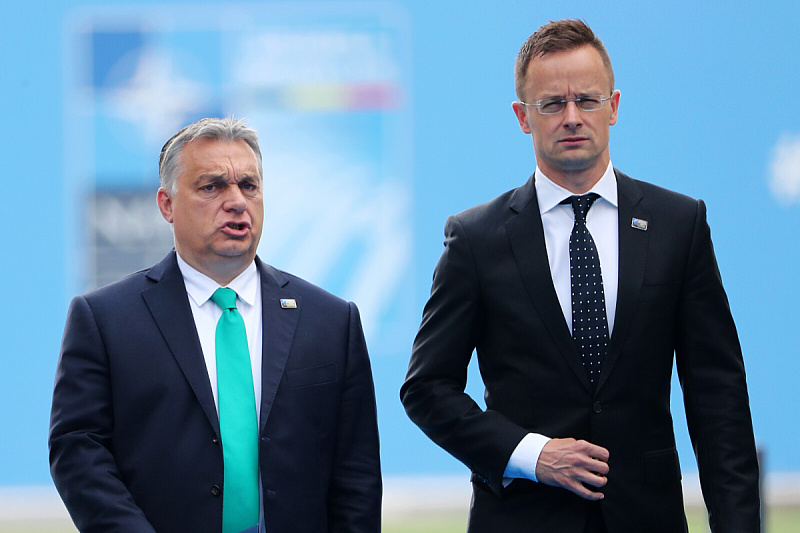
"Our intelligence service has already contacted your services and we will share all information we have gathered during the investigation," Hungarian Foreign Minister Péter Szijjártó told his Iranian counterpart Abbas Araghchi by phone, according to a copy of the September 30 call transcript produced by the Hungarian government and obtained by The Washington Post.
Hungary was then in the spotlight because a Taiwanese company whose brand was on the devices told journalists they were manufactured by a Hungarian firm under a licensing agreement.
Szijjártó sought to emphasize to Araghchi that his country was in no way involved in the September 17 attack in Lebanon, which killed 12 people and injured as many as 2,800, and that the pagers were not produced in Hungary.
However, that call, and Szijjártó’s apparent eagerness to ingratiate himself with the Iranian foreign minister, raises awkward questions about the Orbán government’s relationship with Iran at a time when the Donald Trump administration is in conflict with Tehran, while the White House is supporting Orbán’s campaign.
The call also contradicts the Orbán government’s official pro-Israel policy, often breaking with European partners to support Israel in United Nations Security Council votes, and announcing a withdrawal from the International Criminal Court in April 2025 during a visit to Budapest by Israeli Prime Minister Benjamin Netanyahu, who faces an arrest warrant from that court.
Besides Donald Trump, Netanyahu has also publicly supported Orbán.
Vice President JD Vance arrived in Budapest on Tuesday, just days before Hungary’s April 12 election, to provide a last-minute boost to Orbán’s faltering campaign, in which the pro-Russian Hungarian prime minister trails his centrist rival Péter Magyar in polls.
Vance did not mention concerns about Russian interference, while supporting Orbán’s claim that he faces interference from Ukraine and Brussels in the election, amid tensions over Orbán’s blockade of a €90 billion loan the European Union is seeking to approve for Ukraine. That loan is crucial for Kyiv’s ability to continue defending against the Russian invasion.
The Orbán government has been a strong backer of the MAGA movement, with Orbán leading efforts to present a Christian-nationalist front against migrants across Europe, while also drawing closer to Russian President Vladimir Putin.
Orbán’s campaign is accompanied by reports that his government is collaborating with Moscow, including the fact that Foreign Minister Szijjártó regularly phones his Russian counterpart Sergey Lavrov to provide real-time updates during breaks in sensitive EU meetings.
That claim was further bolstered when several independent investigative media outlets, including Hungary’s VSquare, last week published a leaked recording of a call between Szijjártó and Lavrov in which they coordinated efforts to help Russian billionaires, companies, and banks evade EU-imposed sanctions.
Szijjártó did not deny the recording but downplayed its significance, saying journalists had proven he says the same things publicly as on the phone.
The transcript of the call between Szijjártó and Araghchi raises further questions about the Orbán government’s political allegiances, particularly given Moscow and Iran’s longstanding alliance, as well as the fact that Russia supports Iran in its war with the United States, including providing targeting information for U.S. forces, such as warships and aircraft in the Middle East, according to Western officials.
"I just wanted to personally tell you that our services have already contacted yours," Szijjártó told Araghchi at the time, according to the transcript.
When Araghchi replied that he was "very grateful" for Hungary’s assistance, Szijjártó further denied any involvement of his country in the attack on Israel.
"If you need additional information or want to contact me, I am always at your disposal. These pagers were not produced in Hungary, they have never been in Hungary, and no Hungarian company has ever been physically connected to them. So, we have no connection to this whatsoever!" said the head of Hungarian diplomacy.
At the time, Hungarian government spokesman Zoltan Kovacs reiterated that stance, posting on X that the Budapest-based company listed as the pager manufacturer was actually just a trading intermediary, with no production or operational facility in Hungary.
Kovacs also said that Hungarian national security services cooperate with all relevant international partner agencies and organizations. However, he did not specify whether Iranian security services are among those partners.