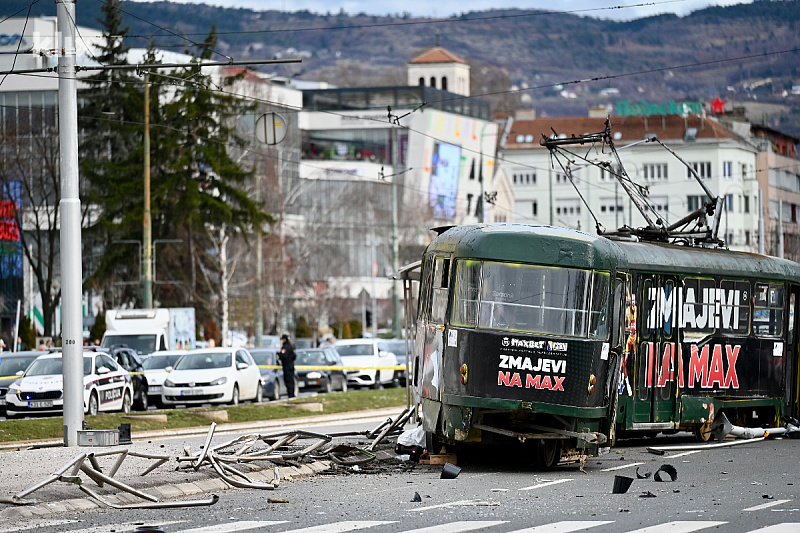
In the accident, 23-year-old Academy of Fine Arts student Erdoan Morankić was killed, and a 17-year-old girl was seriously injured. At the time of the accident, they were standing at a tram stop near the Technical School in Sarajevo.
This accident led to mass protests on the streets of Sarajevo, the resignation of the Sarajevo Canton Government and GRAS director Senad Mujagić, and also raised numerous questions about the safety of public transport in the capital city of Bosnia and Herzegovina.
What all happened?
The day after the tram accident, old trams stopped running on Sarajevo's tracks. The tram driver was arrested on suspicion of endangering public safety, but the court rejected the Sarajevo Canton Prosecutor's Office's proposal to order his detention.
On the same day, a group of young people took to the streets demanding accountability from the responsible institutions and safer public transport. Demonstrations were held during February and early March, but with less intensity than in the first days after the tragedy.
Just three days after the tragedy, the Prime Minister of Sarajevo Canton resigned, leading to the fall of the entire Government. At the time, he emphasized young people and their future, noting that it was the youth who took to the streets, raised their voices, and clearly communicated what they expect from the authorities. The Sarajevo Canton Assembly accepted his resignation on March 6, and since then, the story about a new Government has completely quieted down. Although GRAS director Mujagić also resigned, that move was never accepted.
Although the public was particularly shaken by the information that the tram's surveillance camera was not working, this topic is now rarely discussed in public.
The public never received answers to the question of how it was possible that the surveillance camera was not working, especially since public funds were spent on its installation and maintenance. Thus, at the moment when the surveillance camera was most needed, it was determined that footage of the key event does not exist. It is not known to what extent the lack of footage from the tram cabin will affect the course of the Sarajevo Canton Prosecutor's Office's investigation, but the driver emphasized that it is key evidence that would prove his innocence.
What about the Sarajevo Canton Prosecutor's Office's investigation?
In response to our inquiry regarding the progress of the investigation into the tram accident, the Sarajevo Canton Prosecutor's Office stated that extensive material documentation has been collected so far, and a large number of witnesses have been heard. They added that certain forensic medical examinations have been conducted.
"An order has been issued for a mechanical-electrical expert examination by a team of experts, and upon completion of that examination, an expert examination by traffic experts will also be conducted. Parallel to this, other investigative actions are being taken as assessed by the prosecutors handling the case. Thus, expert examinations are being conducted as ordered by the prosecutor's office, which are crucial for further proceedings," they stated in their response.
They added that the public will be timely informed about further steps and decisions once all relevant evidence is collected and analyzed.
Earlier, the Sarajevo Canton Prosecutor's Office confirmed that surveillance footage from the building of the National Museum and the building of the Embassy of the United States of America has been seized.
"Extensive documentation related to the reconstruction of the entire tram line and signal plans of all relevant intersections has also been seized from the Ministry of Transport of Sarajevo Canton, which will be examined by experts," the Sarajevo Canton Prosecutor's Office stated earlier.
Who will bear responsibility?
After the tragic event, the public has not yet received a clear and final answer to the question of what exactly caused the accident. The investigation is ongoing, but the key circumstances under which the accident occurred are still not clarified.
It is also not known whether the fatal outcome of the accident is the result of human error, technical failure, or a possible combination of several circumstances that unfortunately coincided at that critical moment.
This particular segment of the investigation is considered crucial, as it should show whether the tragedy could have been prevented and who, in that case, should bear the consequences.