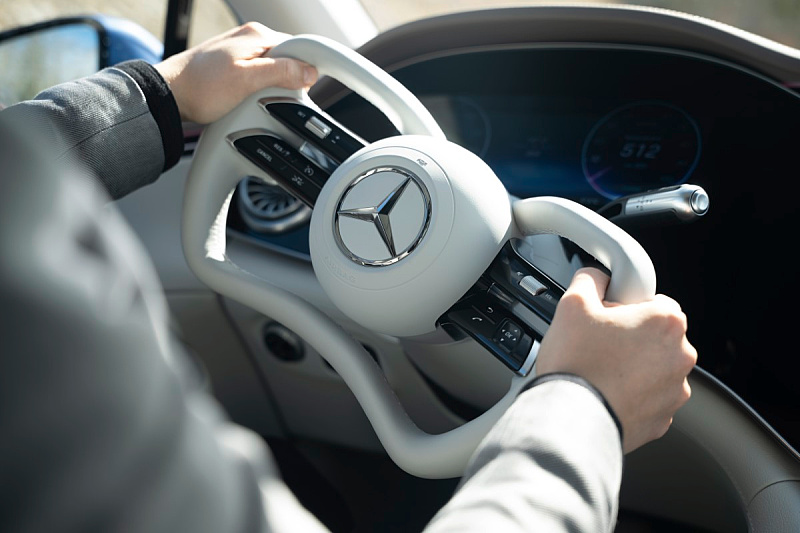
The overall driving dynamics have also been improved. The technology will be available on the EQS model for an additional cost of approximately 2,500 euros, which includes steerable rear wheels. To ensure reliability in everyday use, the system was tested for over a million kilometers before series production, both on test benches and on real roads as well as the company's official test track. The new technology can be ordered regardless of the chosen engine and is compatible with the all-wheel-drive system. Despite this, it will not be standard equipment, so those who do not want "steer-by-wire" can still opt for electromechanical steering. From a safety perspective, the system is designed with dual redundancy, meaning vehicles will have a backup system. All sensors exist in "duplicate," guaranteeing that the driver does not lose control of the vehicle even in the event of a technical failure. The actuator adjusts the intensity of the steering signal based on current speed and driving conditions, while the driver receives feedback through a sensation recognizable in Mercedes models. The system also offers personalization options. Each model can have a different steering character, tailored to the customer's taste. Additionally, road irregularities and vibrations, which in conventional systems pass directly to the steering wheel, are almost completely filtered out by this technology. The only aspect that may require some adaptation is the appearance of the steering wheel itself, whose form irresistibly resembles the controls of an old Messerschmitt cabin scooter. However, customers who prefer a classic round steering wheel can also request that option. The more unusual, flattened variant was not chosen merely for aesthetics—it gives the cabin a feeling of more spaciousness and airiness, facilitates entry and exit, and improves the visibility of the instrument panel. Impressions from the first short test drive by journalists who tried this system on a slalom course speak for themselves. The massive EQS behaves surprisingly agile and obediently with the new technology. Very small movements of the steering wheel are sufficient for precise vehicle guidance, and the automatic "circling" of the steering wheel that every driver has practiced for years is simply no longer necessary. Combined with rear-axle steering, the system enables an enviable level of precision with minimal physical effort. One thing is certain—turning the steering wheel is a thing of the past and is definitively behind us. This is especially true for volume manufacturers, as Peugeot was the first to announce the introduction of this system in the new 208.
Society
Steering the wheel is a thing of the past: Here’s how the new steer-by-wire system works in Mercedes
Mercedes is the first German manufacturer to introduce a steering system to the public that lacks a traditional mechanical connection between the steering wheel and the front wheels. The Steer-by-Wire system debuts in the EQS model, with an additional cost in Germany of around 2,500 euros.
ingestion